Showing posts with label Weird reproduction. Show all posts

Monday, 17 August 2015

Creature 321: Anthopleura elegantissima


Racist anemones

Anthopleura elegantissima is an anemone commonly known as a clonal anemone.
AnthopleuraElegantissima 3732.JPG

Most cnidarians are capable of cloning themselves,  but these guys do it prolifically.  They raise an army of super aggressive clones which destroy any other anemones they come across. They can reproduce sexually, but their offspring are carried by the currents far away to form new colonies.

Aggregating anemones

Clonal anemones have a symbiotic relationship with certain algae. The anemone provides carbon dioxide and protection while the algae provides oxygen and sugars.

Distribution:
The clonal anemone can be found on the west coast of North America.

Classification:
Kingdom: Animalia
Phylum: Cnidaria
Class: Anthozoa
Order: Actiniaria
Family: Actiniidae
Genus: Anthopleura
Species: Anthopleura elegantissima

Image Links:

Saturday, 1 August 2015

Creature 305: Neotrogla

Gender role reversal

Neotrogla is a bizarre insect in the order Psocoptera.

Members of this unusual genus live in caves and survive mostly off bat droppings. Males tend to be choosy while females aggressively seek out mates. Male reproductive organs are reduced to a small opening while female reproductive organs have been modified into a long structure known as a gynosome. During mating the female mounts the male and inserts the gynosome into his genital opening. She then absorbs seminal fluids which is rich in reproductive materials and nutrients. The nutrients are used to produce eggs which are fertilized by the reproductive materials.

Distribution:
Neotrogla can be found in Brazil.

Classification:
Kingdom: Animalia
Phylum: Arthropoda
Class: Insecta
Order: Psocoptera
Family: Prionoglarididae
Genus: Neotrogla

Image Links:

Tuesday, 7 July 2015

Creature 280: Lernaea

Parasitic crustacean

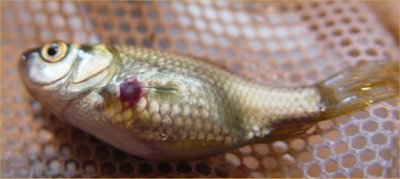
Lernaea is a genius of maxillopod crustacean which are usually called Anchor worms.

They have nine juvenile phases in which they are free living plankton of various forms. Once they are sexually mature they breed. At this point the males simply die off but the females go and find themselves a fish and dig into its flesh. The females body is then modified into a grappling hook shape, or an anchor shape.

The body segmentation and most of the organs are lost. Most of the organism is reduced but a long thin segment can often be seen hanging out of the body of the fish. The female essentially becomes a factory for producing and pumping out fertilized eggs.

Anchor worms are a common pest in fish tanks and aquaria all over the world.

Distribution:
Larnaea can be found all over the world.

Classification:
Kingdom: Animalia
Phylum: Arthropoda
Class: Maxillopoda
Order: Cyclopoida
Family: Lernaeidae
Genus: Lernaea

Image Links:

Wednesday, 27 May 2015

Creature 239: Cymothoa exigua

A crustacean which becomes a tongue

Description:
Cymothoa exigua is an isopod crustacean, which is sometimes called the tongue eating louse.

Some of my regular readers may remember Macrocheles rettenmeyeri, the parasitic mite which replaces the foot of other arthropods. In a similar way this parasitic isopod eats and then replaces the tongue of fish. They enter the fish through the gills and then eat the tongue off. They latch on to where the tongue was and then live off the blood of the fish they have latched on to.

The first member of the species to enter the fish will mature into a male. When a second parasite infects the same fish the first on then becomes female.


Distribution:
Cymothoa exigua is found in tropical waters near coastal areas of the Eastern Pacific Ocean.

Classification:
Kingdom: Animalia
Phylum: Arthropoda
Class: Malacostraca
Order: Isopoda
Family: Cymothoidae
Genus: Cymothoa 
Species: Cymothoa exigua 

Image Links:
http://www.buzzfeed.com/awesomer/there-is-a-parasite-that-eats-tongues-and-replaces-them-with#.grJbQ0w4D1
http://animalus.blog.pl/2013/12/30/cymothoa-exigua/

Tuesday, 28 April 2015

Creature 210: Pipa pipa

This frog is not roadkill. It's supposed to be like that.
Description:
The Pipa pipa is a frog which is commonly called the Suriname toad in English.


When you have a toad which looks like that I don't know why you would name it after its location. Even the scientific name is more interesting as pipa means kite. Why couldn't we call it a kite toad? Anyway as you may have noticed it is very flat. They mimic rotting leaves on the bottom of swamps and slow moving bodies of water and are almost entirely aquatic. Their creepy long fingers are used to feel around for prey while remaining mostly motionless.


Female eggs are attached to their back when they are fertlised and develop in little pockets that form giving the female an even more bizarre appearance. The tadpoles develop here until they are ready to emerge.

Distribution:
The Pipa pipa is mostly found in the North of continental South America but it is also known from Trinidad and Tobago.

Classification:
Kingdom: Animalia
Phylum: Chordata
Class: Amphibia
Order: Anura
Family: Pipidae
Genus: Pipa
Species: Pipa pipa

Image Links:

Friday, 24 April 2015

Creature 206: Ptilonorhynchidae

Impressive mating displays

Description:
Ptilonorhynchidae are a family of 20 species of birds commonly called bower birds.


They are a largish relatively long lived family of birds. The males are not as spectacularly colored as many other birds, and the reason for this is very interesting.  Males attract female attention by doing a dance a structure they build which is called a bower. The bower is not a nest but a display to attract females. Bower birds collect several items of a particular color to decorate their bower to attract the females. The color of the items varies with species.


This behavior is supposed to have evolved from a need to prove to the females that the male is a good forager. It shows that he is good enough at collecting food that he can waste time collecting hundreds of useless rare items. Think of it as the avian equivalent of buying a Ferrari. By mating with a good forager the females increase the chance that their offspring will also be good foragers. Their dance is also funny to watch.


Distribution:
Bower birds are found in Australia and New Guinea.

Classification:
Kingdom: Animalia
Phylum: Chordata
Class: Sauropsida
Order: Passeriformes
Family: Ptilonorhynchidae

Image Links:

Saturday, 21 March 2015

Creature 172: Lophorina superba

That bird can dance

Description:
Lophorina superba is commonly called the superb bird of paradise. This makes it sound pretty awesome.

Actually only the males can be considered in anyway superb, with the females lookimg drab in comparison.  This is fairly common in birds as the females are usually the choosy ones.
Unfortunately for the males of the species there are just as many females as males, which is not all that common for birds. This makes the females extra choosy. Females have been known to reject up to 20 male suitors in a row before deciding to mate. This has led to a bizarre mating dance ritual:

Distribution:
Lophorina superba are common on the Island of New Guinea.

Classification:
Kingdom: Animalia
Phylum: Chordata
Class: Sauropsida
Order: Passeriformes
Family: Paradisaeidae
Genus: Lophorina
Species: Lophorina superba

Image Links:

Video Links:

Friday, 20 March 2015

Creature 171: Idolomantis diabolica

You don't often get devil and flower in the same name.
Description:
Idolomantis diabolica is a praying mantis which is commonly known as the devil's flower mantis.


They are a large species of mantis with females reaching up to 13 cm in length. They are quite a bizarre looking mantis due to their adaptations both to mimic a flower when hunting their prey and to appear larger than they are when they are threatened. When hunting they remain perfectly still and hide the colourful flaps under their legs. When they are threatened they stick their legs in the air and reveal the flaps giving them the appearance of being larger than they are. They have very sharp and very efficient mandibles and are quite fond of using them to decapitate their prey.


In many species of Praying mantis, including the devil's flower mantis, the predatory instincts are so strong that males need to be very careful when they approach a female to copulate. The female will often decapitate the male before during or after copulation. Males have evolved a solution to this. If their head does happen to get severed from their body they are preprogrammed to run around in circles trying to find a female to complete copulation with.


Distribution:
Devil's flower mantis is endemic to East Africa.

Classification:
Kingdom: Animalia
Phylum: Arthropoda
Class: Insecta
Order: Dichtyoptera
Family: Empusidae
Genus: Idolomantis
Species: Idolomantis diabolica

Image Links:

Monday, 2 March 2015

Creature 153: Greta oto

This butterfly just has to be different

Description:
Greta oto is a species of butterfly which in English is referred to as a Glass winged butterfly. It gets its name from its unusually transparent wings.

Most butterflies are known from their brightly colored wings,  which are a result of a multitude of tiny scales. The glass winged butterfly decided it wanted to be different and lacks the scales present on other butterflies except around the edges. Most insect wings are fairly transparent, but dense venation and the fact that you usually on see them when they folded over the abdomen give them a translucent appearance. The glass butterfly looks unusual because you can easily see straight through its wings.

Glass winged butterflies lay their eggs on toxic nightshade plants. Their caterpillars have a tolerance to the poison which accumulates in their tissue making them poisonous and protecting them from predators. Adult males use the poison to produce pheromones. When they are ready to breed several males gather together and release pheromones together increasing the chance of female encountering the group. The males in the group will then compete with each other to get the attention of the females. This behavior is known as lekking.

Distribution:
Glass winged butterflies are endemic to Central America and Southern United States.

Classification:
Kingdom: Animalia
Phylum: Arthropoda
Class: Insecta
Order: Lepidoptera
Family: Nymphalidae
Genus: Greta
Species: Greta oto

Image Links:

Monday, 16 February 2015

Creature 139: Stemonitis fusca

No this is not an alien
Description:
Stemonitis fusca is a slime mold, and if you haven't heard of slime molds you should read my post on the dog vomit slime mold to learn a bit about this bizarre group of organisms. When it enters it's reproductive phase it looks quote bizarre.

Stemonitis fusca lives in rotting wood slowly consuming the decomposing plant matter. When conditions are right the form visible bubble like structures which fuse together. These the grow into elongate tubes. Then thin wiry stalks lift the whole structure up giving it as much height as possible so the slime mold can disperse it's spores. It will change color quote dramatically while reaching ripening. Watch it happen here:


Like most slime molds the individual cells are capable of living apart and then fusing together into a single multinuclear cell which forms the fruiting body.


Distribution:
Stemonitis fusca can be found on rotting wood anywhere in the world.

Classification:
It may look a bit like a mushroom, but I cannot emphasis enough that these arr not fungi. They were once classified as fungi, but have subsequently moved to the Kingdom Amoebozoa.

Kingdom: Amoebozoa
Phylum: Mycetozoa
Class: Myxogastria
Order: Stemonitida
Family: Stemonitidae
Genus: Stemonitis
Species: Stemonitis fusca

Image Links:

Video Links:

Thursday, 22 January 2015

Creature 114: Claviceps purpurea

Fungus which grows on your food and makes you psychotic
Description:
Claviceps purpurea is a parasitic fungus which infects various flowering plants, mostly grasses and particularly rye.

Infection of cereals like rye by this fungus occurs while the plant is in flower. The spores of Claviceps purpurea mimic pollen and make their way to an ovary. The ovary is destroyed ant the fungus consumes the nutrients which were meant for the developing seeds. As the fungus develops it clones itself sending out millions of tiny clone spores which are picked up by insects can infect other plants. Eventually it grows into the long seed like structure you see above. This structure encased living fungal tissue which lies dormant until the conditions are right. When the environment becomes favorable for grasses to flower the pod opens and the fungal fruiting bodies (mushrooms) grow. In this phase the fungi breed and send out a new generation of spores.

That's all fairly interesting,  but considering this fungus commonly infects a fairly major human food source you are probably wondering what effect it can have on humans. The fungus produces various alkaloid toxins which can have nasty effects on humans. Poisoning by these toxins is known as ergotism. Mild poisoning may only cause headaches and diarrhea, but symptoms will progress to seizures and spasms as well as full blown psychosis. Prolonged exposure can wreck havoc on your vascular system causing gangrene which may result in the loss of limbs and eventually death.

Infected cereals can be seen as the dark purple to black fruiting bodies stand out especially as they are usually much larger than the seeds of the cereal, although they can be slightly smaller than the seeds of wheat. The fungus and it's effects have been known for a long time and has been studied at least since the 17th century. Outbreaks of the fungus are believed to be responsible for various unusual historic events which could have been caused by mass psychosis such as the Salem which trials.

Distribution:
Claviceps purpurea is occasionally found anywhere where rye is cultivated.

Classification:
Kingdom:Fungi
Phylum: Ascomycota
Class: Sordariomycetes
Order: Hypocreales
Family: Clavicipitaceae
Genus:Claviceps
Species: Claviceps purpurea

Image Links:

Sunday, 18 January 2015

Creature 110: Hypsignathus monstrosus

Not sure weather to scream or laugh?

Description:
Hypsignathus monstrosus is a monstrosity commonly known as the hammer-headed bat or the big lipped bat. It looks like a bizarre combination of a cartoon dog and a vampire in bat form.
Male hammer-headed bat

The females look a lot different to the males. The extreme modification of the mouth and throat are used in males for making highly specialized mating calls. During mating season the males all gather in a single location and call out to the females. As the females approach they pick whichever male has the most appealing song. As they get close the male changes its song and does a little dance.

Female Hammer-Headed bat


Distribution:
Hypsignathus monstrosus is endemic to West-Central Africa.

Classification:
Kingdom: Animalia
Phylum: Chordata
Class: Mammalia
Order: Chiloptera
Family: Pteropodidae
Genus: Hypsignathus monstrosus
Species: Hypsignathus

Friday, 16 January 2015

Creature 108: Cimex lectularius

You'll be glad they only suck your blood.

Cimex lectularius is a species of which bear the very common name of bed bugs. There are a lot of myths about these blood sucking pests but in this case the reality may be more bizarre than the fiction.


First of all bed bugs can't grow more than about half a centimeter long, you can see them but they are not the size of a large cockroach. If you think you have seen one that big it was probably a cockroach. They cannot transmit diseases as far as we can tell, and at this stage it has been looked into quite extensively. They are very hard to get rid of, but not impossible and old furniture or clothes do not need to be burnt. They are often hard to find as they can live in carpets, skirting boards, mattresses etc... but again it is not impossible. They do specialize in sucking human blood and they can be very hard to get rid of. They hide during the day usually inside the mattress or in nearby carpet, skirting boards etc.. They can tell you're around by the Carbon Dioxide you exhale and your body heat. Their eggs are very tough and hard to destroy which is why if the colony has been well established extermination has to be done thoroughly or the colony can reestablish itself in a few weeks.


Cimex lectularius have a very strange method of reproduction.  Male bedbugs have their parameres modified onto a single fused hardened sharp needle like structure. This is used to puncture the female's abdomen and the sperm in injected into the females haemolymph (the insect equivalent of blood). The sperm will find it's way to the female's sperm storage organs to be used for fertilizing eggs later. This method of reproduction, known as traumatic insemination, occurs in several different true bug groups. In bedbugs the females have developed a secondary organ known as a mesospermalege which they direct the males to during mating. This reduces the damage done to them by the males.

Male bedbug's fused parameres

Bedbugs produce a pheromone when they are in danger which alerts other bedbugs to the fact that there may be a predator around. The males also use this pheromone to prevent other males from attempting to mate with them as they seem to have no other method for determining males from females. Like other true bugs they have long tubular piercing mouth parts for feeding as you can see in this assassin bug.


Distribution:
Bedbugs are found everywhere there are humans. They are believed to have coevolved with humans from the time when we mostly lived in caves. They probably were originally bat specialists like the rest of their genus but jumped hosts when humans began to inhabit the caves which the bats were living in. They are most likely from somewhere in the Middle East.

Classification:
The other members of the genus Cimex are called bat bugs and usually live among bat colonies. Some of these have been known to feed off human if they are hungry. Several other species in the family Cimicidae are sometimes referred to as a type of bedbug. I prefer to use this term only for the true bedbug Cimex lectularius as the rest don't form anything resembling a monophyletic group.

Kingdom: Animalia
Phylum: Arthropoda
Class: Insecta
Order: Hemiptera
Family: Cimicidae
Genus: Cimex
Species: Cimex lectularius

Image Links:

Tuesday, 6 January 2015

Creature 98: Larrea tridentata

The oldest living thing on earth.
Description:
 Larrea tridentata is a unimpressive looking desert bush which has many common names such as cresote bush, greasewood and gobernodora.

Cresote bush is technically the oldest living thing on Earth. When the plant gets to 30 to 90 years old its branches begin to die. At that point the plant splits in two and the old plant dies off as its clone lives on. The clonal colonies form rings of bushes. Individual bushes can grow up to 4 m tall, but usually don't grow more than 2 m tall. The oldest known specimen is known as king clown which lives in the Mojave Desert and is believed to be 11,700 years old. It is a ring of clonal bushes, the largest of which is 20 m in diameter.


These bushes are normally found with no other plants in the immediate vicinity due to its incredibly efficient systems for collecting water, which will starve other plants of access to water. The plant was used by native Americans as a herbal medicine.

Distribution:
Cresote bush is found in the Western Deserts of North America.

Classification:
Kingdom: Plantae
Phylum: Angiosperms
Class: Dicotyledon
Order: Zygophyllales
Family: Zygophyllaceae
Genus: Larrea
Species: Larrea tridentata

Image Links:

Tuesday, 16 December 2014

Creature 77: Fuligo septica

A shape shifting monster in your garden.

Fuligo septica may sound like a fairly disgusting name for a species, but its common name, the Dog vomit slime mould sounds even worse. They may look quite disgusting,  but they are actually very cool creatures.

Description:

The slime moulds have several phases to its life cycle. It life cycle starts off as an single cellular organism much like an amoeba. They reproduce asexually for a while while mostly eating bacteria. When conditions are right these amoeboid can breed with each other. The result of this breeding is a multi nuclear blob without any cellular division which can either be thought of as a single cell with multiple nuclei or multiple cells with a fused cytoplasm. This monstrosity can grow meters in size as it consumes micro-organisms in its path. The freakiest thing about it is that it is capable of self movement. O.k. it is not very fast, sometimes it can achieve speeds of over 1 mm a second, but that's still pretty weird.

When the yellow blob has consumed all the food in the area it transforms. At this point the slime mould will form reproductive bodies which shoot out spores in order to colonise areas with more food. It is in this stage that the dog vomit slime mould is normally noticed as a bright yellow or greyish slimy blob. There are some really interesting fruiting bodies, some of which are mobile but we will talk about these in later posts. Dog vomit slime moulds are believed to use beetles to spread their spores.

Like animals and unlike fungi slime moulds lack chitin in their cell walls making the shape of their cells less rigidly defined.

Distribution:

Dog vomit slime mould is found throughout the world and are particularly common in garden compost.

Classification:

The slime moulds used to be considered to be a group of fungi, mostly because the fungi used to be classified by the absence of characteristics which is always a bad way to classify organisms. They are considered to be more closely related to Animals than fungi and are a member of the Amebozoa Kingdom.

Kingdom: Amoebozoa
Phylum: Mycetozoa
Class: Myxomycetes
Order: Physarales
Family: Physaraceae
Genus: Fuligo
Species: Fuligo septica


Wednesday, 3 December 2014

Creature 64: Toxoplasma gondii

Does this mind altering parasite control the internet? 
Description:
Toxoplasma gondii is a single celled eukaryote which is an obligate parasite on vertebrates, particularly mammals. It is always capable of asexual reproduction but is only capable of sexual reproduction when it is infecting feline species. Cats are obviously it's preferred host, so it has come up with a pretty cool trick to make their way into cat hosts if they find themselves to be infecting rodents. Rodents naturally have a rather sensible fear of the smell of felines. A minor adjustment of the rodents brain chemistry by these parasites change that fear into an attraction. You can imagine how long a rat would last if it was attracted to the scent of a cat. Among other methods the parasite is transmissible by the consumption of raw meat.
Toxoplasma gondii cell


Given that all mammal brains are variations upon the same theme you're probably wondering of your pet could be infected with this mind altering parasite, whether it could infect you and whether it can have an influence on your mind. The answers are yes, yes and yes. A 2009 study estimated that up to a third of the human population are carriers of Toxoplasma gondii. In healthy individual It can cause mild cold-like symptoms for the first few weeks after infection and will normal form cysts in the muscle tissue and remain latent. In immunocompromised individuals such as those suffering from AIDS, the very young or the very old it can develop into more severe symptoms and is known as toxoplasmosis. It can be transmitted from a mother to her child before birth and has been associated with miscarriages in humans.
Toxoplasma gondii cyst


The parasite can infect the human brain and once it is there it excretes a  neurotransmitter called gamma-Aminobutyric acid which reduces the excitability of neurons. This neurotransmitter relaxes and reduces anxiety in humans. Given our evolutionary association with large feline predators the question should be asked as to weather it is doing the same thing to us as it does to the rodents. There is no evidence to suggest that they make humans more attracted to cats but have you seen how many cat pictures there are on the internet? Try explaining that logically. Also check out this xkcd comic: http://xkcd.com/231/. We've all seen people who behave like that around cats, doesn't that just say mind control parasite to you? There has been some unconfirmed association between Toxoplasma gondii and schizophrenia.

Distribution:
Toxoplasma gondii is found in hosts in all terrestrial environments.

Classification:
Protozoan classification confuses me, so I blindly copied Wikipedia's classification.
Kingdom: Chromalveolata
Phylum: Apicomplexa
Class: Conoidasida
Order: Eucoccidiorida
Family: Sarcocystidae
Genus: Toxoplasma
Species: Toxoplasma gondii

Friday, 14 November 2014

Creature 45: Heterocephalus glaber

The naked molerat... and that's being nice.
Description:
Heterocephalus glaber is commonly known as the naked molerat, and if you think that this name rather unflattering, take a look at it:

Those incredibly large teeth are not only capable of moving around, but can move independently of one another and are predominantly used for tunnelling. Those long scrawny whiskers are used to feel their way around their tunnels as light is limited and their eyesight is poor.

Not only is this one of the ugliest mammals alive, but has a very unusual social structure. They live underground, usually in colonies of a few dozen but can contain up to a few hundred. Colonies have one queen, the only reproductively active female, and a few reproductively active males. The rest of the colony is made up of sterile worker or soldier drones. The queen produced pheromones to stop other females from becoming reproductively active queens, once a queen dies the females compete to become the new queen.

This is one of the very few examples of eusociality outside of the insects.
One can hardly mention naked molerats without pointing out the fact that they don't feel pain when they come in contact with acid. This is said to be an adaptation to living in high carbon dioxide environments. They are very long lived (up to 31 years) and they seem to have a resistance to cancer.

Distribution:
The naked molerat is endemic to the horn of Africa.

Classification:
Kingdom: Animalia
Phylum: Chordata
Class: Mammalia
Order: Rodentia
Family: Bathyergidae
Genus: Heterocephalus

Monday, 10 November 2014

Creature 41: Hemiphractidae

A very creepy frog
Description:
Hemiphractidae is a diverse family of frogs commonly known as marsupial frogs. Marsupial frogs earned their name from their unusual reproductive behavior.

If you are wondering what those lumps on its back are and you are nervously thinking of the name marsupial frog you're worst suspicions are correct.  Those lumps are full of tadpoles wriggling around as they grow large enough to tear open their mothers pouch and break free. Something about that seems really creepy even thought it is not all that different from mammalian reproductive strategies. The eggs are externally fertilised, as is standard in frogs, they are then moved onto the females back by the male.

The different generea and species of Hemiphractidae develop to different stages while inside their mothers skin. Some are released into the water as eggs, while others do not leave until they complete their tadpoles phase.
To add a little bit of creepiness to these frogs, Gastrotheca guentheri (a type of marsupial frog) is the only frog with teeth on its lower jaw.

Distribution:
Hemiphractidae are a tropical family found in central and south America.

Thursday, 6 November 2014

Creature 37: Wolbachia

A bacteria which  can change males to females

Description:
Wolbachia is a genus of bacteria which has been co evolving with its insect hosts for a very long time and has possibly plagued insects ancestors since before they branched off from the crustaceans.
Wolbachia can be transmitted in insects from a mother to her offspring through infected eggs, a trick which does not work in male sperm. Given the amount of evolutionary time that they have to co evolve this has lead to some interesting adaptations in order to ensure they are transmitted to ensuing generations. From an evolutionary perspective the Wolbachia obviously prefer female hosts. This has lead to some bizarre adaptations when insects are infected.

Insect cell infected by Wollbachia (the large distinct oval shapes)

We mentioned parthenogenesis in yesterday's post. It has been shown that in some insect branches Wolbacia are responsible for enabling parthenogenesis in female insects leading to a generation of infected clone females. It is possible that Wolbachia are responsible for parthenogenesis in all insects which employ this strategy.
In some insect lineages Wolbachia have been known to kill males before they are born in order to eliminate the competition for the infected females.
In some lineages Wolbachia has been known to change males into females when they are infected early in their development.  They will grow up to be fully functional females or sterile feminized adults depending on the species. The sterile feminized cast does not really make sense to me and I assume it is just an evolutionary mistake as a result of the fact that not all insects require the same things to become female.
In some lineages Wolbachia makes males unable to reproduce with females which are not infected with the same strain of Wolbachia.
Wolbachia infections have also been known to cause females to increase egg production resulting in more offspring to the long term detriment of the host.
Interestingly these bizarre bacteria do have their uses to us. Wolbachia have been shown to give insects a resistance to certain viruses, including some insect transmitted viruses which infect humans. Wolbachia infected mosquitoes have been used to spread infections among mosquito populations in order to control the spread of dengue fever.

Distribution:
Wolbachia is found wherever there are insects, which is everywhere. 

Classification:
Kingdom: Bacteria
Phylum: Proteobacteria
Class: Alphaproteobacteria
Order: Rickettsiales
Family: Rickettsiaceae
Genus: Wolbachia

Image links:

Wednesday, 5 November 2014

Creature 36: Aphididae

A bug which is born pregnant

Aphididae are commonly called aphids. I know what you are thinking right now, who cares about aphids? I saw hundreds of them this morning, but any story as weird as this deserves a place on this blog. If you think aphids are very common, you are right. there are over 4,000 known species and that's probably just the tip of the iceberg. Many of the species are incredible numerous and widespread.

 If you think that makes them boring, you are wrong. Aphids females are capable of cloning themselves. They can literally produce an exact genetic replica of themselves without breeding, so they don't need males unless they want to produce males or genetically different females. This is known as parthenogenesis and is not as uncommon as you may think. Many insects and other invertebrates do it and it even happens in some lizards. It has been speculated that there may be species out there in which males have gone extinct altogether and female populations just replace themselves via parthenogenesis. Now while there may be some feminists out there who are quite partial to the idea I imagine they might change their mind once they hear what it has led to in these aphids.

Unlike most insects aphids are viviparous meaning they give birth to free living young rather than laying eggs. From an evolutionary perspective there is really no reason to wait to adulthood to begin the development of viable eggs if you are just cloning yourself. Aphids do not give birth until they reach adulthood but at least in some species the development of their clones begins before they are even born.

Aphids can reach adulthood in a matter of days, and have been known to give birth 10 days after they are hatched. This may shed some light on how aphids repopulate your garden so quickly after you have all but wiped them out.

The aphid lifecycle is quite interesting in some species, I won't do through it all here but if you are interested check out the soybean aphid lifecycle.

Distribution:
Aphids are everywhere, you can't escape them, they are EVERYWHERE.
(everywhere excludes marine environments and Antarctica)

Classification:
Kingdom: Animalia
Phylum: Arthropoda
Class: Insecta
Order: Hemiptera
Family: Aphididae

Image Links:
http://commons.wikimedia.org/wiki/Category:Aphis_idaei#mediaviewer/File:Aphis.idaei.-.lindsey.jpg
http://commons.wikimedia.org/wiki/Category:Greenidea_ficicola#mediaviewer/File:Greenidea_ficicola.jpg
http://commons.wikimedia.org/wiki/File:Russian_Dolls.jpg#