Showing posts with label Extreme survival. Show all posts

Wednesday, 29 July 2015

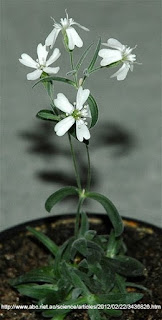
Creature 302: Silene stenophylla

Frost resistant for 32 000 years

Silene stenophylla is a fairly ordinary small weedy looking plant which doesn't look very interesting.

Given its natural habitat is the arctic tundra it naturally needs to be fairly frost tolerant, especially the seeds. In fact one seed found in 32 000 year old Siberian ice was successfully germinated in a laboratory in Russia.

The seed was buried by an ice age squirrel,  much like in the the movie.


Distribution:
Silene stenophylla can only be found in the Russian far east and Alpine regions of Northern Japan.

Classification:
Kingdom: Plantae
Phylum: Angiosperms
Class: Dicotyledon
Order: Caryophyllales
Family: Caryophyllaceae
Genus: Silene
Species: Silene stenophylla

Image Links:

Friday, 24 July 2015

Creature 297: Tornatellides boeningi

Bird's digestive tract. The only way to travel.

Tornatellides boeningi is a small terrestrial snail common on islands throughout the pacific ocean.
That may seem odd as a small terrestrial snail has no chance of migrating hundreds of kilometers between islands on its own. So how did they get to so many islands?

Tornatellides boeningi often get eaten by birds, but these guys somehow have an uncanny ability to shrug it off. That's right they are capable of surviving being eaten by birds. When they come out the other end they are often fine. This doesn't work all the time, but when it does they apparently suffer no ill effects. Presumably they are spread between islands by birds feeding on one island and then moving on.


Distribution:
Tornatellides boeningi can be found on various islands throughout the Pacific.

Classification:
Kingdom: Animalia
Phylum: Mollusca
Class: Gastropoda
Order: Heterobranchia
Family: Achatinellidae
Genus: Tornatellides
Species: Tornatellides boeningi

Image Links:

Tuesday, 21 July 2015

Creature 294: Notaden bendetti

A frog without water

Notaden bendetti can be called the Crucifix toad or the Holy cross frog. It is a smallish frog with a cross like color pattern on its back.


Their endemic range is a classic boom/bust ecosystem. It is usually dry with occasional flooding rains causing living thing to spring into action and reproduce before their habitats dry up again. This type of ecosystem is problematic for amphibians, who rely of water for at least part of their life-cycle. These guys get around the problem by burrowing under the ground and building themselves a sort of cocoon in which they wait for rain. When it does rain they quickly emerge, breed and lay their eggs. The new generation grow to adulthood within a few weeks to take advantage of the short window of opportunity provided by rain.


These toads also produce a strong adhesive glue when threatened. We are not actually sure what this is for, but it is very strong.

Distribution:
The Crucifix toad is endemic to the eastern desert biological region of Australia.

Classification:
Kingdom: Animalia
Phylum: Chordata
Class: Amphibia
Order: Anura
Family: Myobatrachidae
Genus: Notaden
Species: Notaden bendetti 

Image Links:
http://kadesscienceproject.blogspot.com.au/2010/05/vertebrate-amphibian-crucifix-toad.html
http://www.comicvine.com/forums/off-topic-5/impurest-s-guide-to-animals-58-crucifix-toad-1652015/


Thursday, 9 July 2015

Creature 282: Hesiocaeca methanicola

Evolution beats sci-fi again

Under extreme conditions methane and water can freeze together to form an unusual crystal. These crystals are rather unoriginally called methane ice or methane clathrate or sometimes given the more interesting name fire ice. Originally we thought methane ice only existed on the outskirts of our solar system, until we found out that there were natural deposits trapped under the sea floor.

You wouldn't consider these deposits as receptive environments for life in general, but in 1997 Hesiocaeca methanicola was discovered living on top of these crystal deposits in the Gulf of Mexico.
These little worms wander around eating bacteria that feed of the unusual chemical environments around the sea ice crystals. A lot of the water they live in lacks dissolved oxygen. These can survive without oxgen for up to 96 hours.

Distribution:
Hesiocaeca methanicola can only be found in methane ice deposits at the bottom of the ocean, but can probably occur anywhere where these are found.

Classification:
Kingdom: Animalia
Phylum: Annelida
Class: Polychaeta
Order: Phyllodocida
Family: Hesionidae
Genus: Hesiocaeca
Species: Hesiocaeca methanicola

Image Links:

Sunday, 24 May 2015

Creature 236: Riftia pachyptila


An animal which can't eat
Riftia pachyptila is commonly known as a giant tube worm.


These worms can grow up to two and a half meters long, but several parts of their morphology have been highly modified or reduced to vestigial. Instead of a mouth and digestive system Riftia pachyptila relies on a symbiotic relationship with various microbes. The red tip is a feather-like structure called a plume. It is similar to some gills, except it is used to provide more than just Oxygen, it absorbs various dissolved gases which the microbes need to grow and reproduce. In return the microbes provide the nutrients which the giant tube worm needs to survive. As a result of this the giant tube worm is highly tolerant to certain chemicals such as Hydrogen Sulfide, which its dependent bacteria can metabolize. The plume can be retracted back into a hardened tube for protection.


Distribution:
Riftia pachyptila are found living near hydrothermal vents in the Pacific ocean.

Classification:
Riftia pachyptila is in the same phylum as Earthworms.
Kingdom: Animalia
Phylum: Annelida
Class: Polychaeta
Order: Canalipalpata
Family: Siboglinidae
Genus: Riftia
Species: Riftia pachyptila

Image Links:
http://en.wikipedia.org/wiki/Giant_tube_worm
http://bioweb.uwlax.edu/bio203/s2007/rossing_jaco/introduction__the_worm_under_inv.htm

Thursday, 21 May 2015

Creature 233: Phoenix dactylifera

The phoenix rises again after 2000 years.


Phoenix dactylifera is one of if not the oldest cultivated fruit in the world, with evidence of them being cultivated as early as 6000 BC. They are commonly known as date palms and as the name suggests they are the sources of the fruit known as dates.


They are highly tolerant to arid conditions growing in many areas of the Middle East and North Africa. Like many arid species their seeds are highly resistant to ageing and can last a long time before conditions are appropriate for them to germinate and grow. So how long can their seed last? The Judean date palm, which is a subspecies of date palm which used to be common in ancient Judea, was believed to have gone extinct around 500 AD. Apparently they used to be a major part of the Judean economy before the destruction of the second temple. They apparently used to form thick forests in their ideal climates and were a very effective agricultural crop given the harsh conditions of the region. In the 1960s a jar of stored date palms from the Fortress at Masada were excavated. They were carbon dated to between 155 BC and 64 AD. They are likely to be from the latter part of this time frame as the siege of Masada ended in either 73 or 74 AD. Three of these seeds were planted in 2005 in southern Israel, and one of them sprouted. Despite the fact that the original leaves that sprouted looked practically dead as they were densely covered in white lines the plant survived and by 2010 the plant grew to 2 meters tall. The plant was named Methuselah as it has lived for so long. Unfortunately date palms require male and female plants to germinate and it is impossible to grow a pure Judean date palm from a single specimen. Methuselah is a male plant and will be crossed with similar date palm subspecies in order to get a hybrid.

Distribution:
Date Palms are probably native to Mesopotamia and the Levant but have been cultivated across in many warm parts of the world both humid and arid.

Classification:
The name for the genus Phoenix is quite appropriate considering that this subspecies has risen again from the ashes of extinction.
Kingdom: Plantae
Phylum: Angiosperms
Class: Monocotyledon
Order: Arecales
Family: Arecaceae
Genus: Phoenix
Species Phoenix dactylifera

Image Links:
http://brookebenoit.com/2010/08/
http://en.wikipedia.org/wiki/Judean_date_palm#mediaviewer/File:JudeanDatePalmMethuselah.JPG

Saturday, 16 May 2015

Creature 228: Halorubrum lacusprofundi

My regular readers may remember the post on square arechea. Today I am posting another species of Halobacteria, Halorubrum lacusprofundi .  Halobacteria are a class of archea. This may seem confusing as their name contains the word bacteria, which are completely different from archea. For this reason they are usually referred to as Haloarchea.


Halorubrum lacusprofundi lives in water which is saturated or close to saturated with salt, a very hostile environment for most living things on Earth. They are named after Deep lake in Antarctica where they were found. Deep lake gets to temperatures of -20 degrees Celsius.  Hang on, you're probably thinking, wouldn't the lake freeze over at those temperatures?  This lake doesn't because it is so salty the freezing point is significantly lower than normal. The lake contains an average of 27÷ salt.


Oddly enough the highly specialized Halorubrum lacusprofundi  was not the only microbial species to be found in this ridiculously hostile environment.  Several other species including some algae were found, but I chose to write about this one as it is named after the lake (lacusprofundi meaning deep lake).

Distribution:
As far as I can tell Halorubrum lacusprofundi  has only been found in Deep Lake, Antarctica.

Classification:
Kingdom: Archaea
Phylum: Euryarchaeota
Class: Halobacteria
Order: Halobacteriales
Family: Halobacteriaceae
Genus: Halorubrum
Species: Halorubrum lacusprofundi 

Friday, 15 May 2015

Creature 227: Grylloblattodea

Insects that live on ice

Grylloblattodea are either an order or a suborder of insects, depending on who you ask. You can call them ice crawlers or rock crawlers.


There are a confusing group, even their name suggesting that they have some characteristics of both crickets and cockroaches.


Most insects thrive in hot weather, but these guys have evolved specifically to increase their metabolism in the cold. Their optimal living temperature is between 1 and 4 degrees Celsius. They live close to the soil among sheets of ice and sometimes even among glaciers. They feed mostly on dead arthropods.

Distribution:
Ice crawlers can be found in mountainous regions of Northern Asia and the West of North America.

Classification:
As I mentiones there are some entomologists who think the Grylloblattodea should be an Order unto themselves, but for now I am happy to call them a suborder of Notoptera, which also includes Mantophasmatidea. The closest relative to the Notoptera is probably either Dermaptera or Orthoptera or both.
Kingdom: Animalia
Phylum: Arthropoda
Class: Insecta
Order: Notoptera

Image Links:

Friday, 10 April 2015

Creature 192: Proteus anguinus

How long can you go without food?
Description:
Proteus anguinus is a Salamander which is commonly known as an olm.

The olm has adapted to life in underground caves and displays many characteristics which are considered troglodytic such as blindness and pale skin. They are also interesting because although they are amphibians they are completely aquatic, living their entire lives in the water. They almost certainly evolved from an ancestor with terrestrial adults.

They have also adapted to the scarcity of food in some of those cave ecosystems. They can smell food better than any other amphibian, and as they may not get food very regularly they have developed very efficient means of storing energy in their liver. They can live up to ten years without eating.

Description:
The olm is only found in the limestone caves of central Europe and the Baulkans.

Classification:
Kingdom: Animalia
Phylum: Chordata
Class: Amphibia
Order: Caudata
Family: Proteidae
Genus: Proteus
Species: Proteus anguinus

Image links:

Wednesday, 18 March 2015

Creature 169: Archaeoglobus

These guys can eat rocket fuel
Description:
Archaeoglobus are a genus of archea, which are the most primitive branch of living things in the world, as we have discussed earlier.

Some of the species in this genus have evolved the ability to break down almost any source of carbon and use it to grow. It can even carbon based materials like oil and rocket fuel for energy. They have been known to eat sulfur compounds as well as complex plastics and many other things. They can cover themselves in a biofilm which makes them very difficult to destroy with conventional methods.

So you are probably wondering why these guys haven't spread and consumed the whole world yet. The truth is that they have some pretty severe weaknesses.  First of all they don't survive well at low temperatures, and when I say low I actually mean less than 60°C. These guys are perfectly comfortable at temperatures less than the boiling point of water. Once the water starts boiling they begin to struggle. This is bizarre in itself because DNA will usually start to denature at 60 to 70°C, so as a general rule these are not good conditions for life as we know it. Probably their biggest weakness in an Earth like environment is that they can't tolerate atmospheric Oxygen. It is a deadly poison to them.

Distribution:
Archaeoglobus are found in hydrothermal vents and in various underground habitats such as warm oil fields all over the world.

Classification:
Don't ask me about Archean Classification. 
Kingdom:Archaea
Phylum:Euryarchaeota
Class: Archaeoglobi
Order: Archaeoglobales
Family: Archaeoglobaceae
Genus:Archaeoglobus

Image Links:

Tuesday, 17 March 2015

Creature 168: Crysomallon squamiferum

A snail with iron armor
Description:
Crysomallon squamiferum is a recently discovered (2001) snail which has been given the rather boring common name of scaly foot gastropod.


It is a deep sea snail that lives around hydrothermal vents in the deep ocean. Their shell has been modified to easily resist the pressure of the deep ocean. As well as an inner layer of calcium carbonate and a middle layer of tough but flexible protein they have a reinforced outer layer of iron sulfides. Most snails, like dragons, have a soft underbelly which is a weakness that these ironclad snails have managed to circumvent. Like Smaug they have coated their underside with toughened scales. These scales are also made of iron sulfides.


Distribution:
The scaly foot gastropod was found in a hydrothermal vent on the Central Indian Ridge in the Indian Ocean.

Classification:
Kingdom: Animalia
Phylum: Mollusca
Class: Gastropoda
Order: Neomphalina
Family: Peltospiridae
Genus: Crysomallon 
Species: Crysomallon squamiferum 

Image Links:

https://ferrebeekeeper.wordpress.com/tag/crysomallon-squamiferum/
https://www.esa.org/esablog/research/iron-plated-snail/

Saturday, 10 January 2015

Creature 102: Haloquadratum

It's life, but not as we know it.

 I get a fair few pageviews from France and given the events of the last couple of days I would like to say to any French readers out there Vive la France.

Archea are a bizarre group of single celled micro-organisms. They are the basal group the the rest of the extant living things.In layman's terms, compared to archea we are close relatives of bacteria. As the basal living organism they have a wide variety of highly unusual (to us) properties and discoveries of new archea often redefine life as we know it. This bizarre group if often placed in its own category at a level above kingdom which we label Domain. Within it there are several bizarre branches of life which could have become the dominant forms of life on Earth but didn't. If you are a sci-fi writer looking for inspiration start here. This is the first of many archea I will include on this blog.

Description:
Haloquadratum is a genus of archea with the common name of salt squares. You can guess at where part of this name comes from when you look at this picture.

That's right their cells are perfectly square with sharp edges. Their ridiculously geometric cells often join together to form narrow fragile sheets. One can't help imagining that this is a possible precursor to a multicellular state. Their rigid cells contain several structures filled with gasses that give them th buoyancy necessary for living on the water's surface.

Like other members of their family Haloquadratum draw their energy from sunlight through a process entirety unrelated to plant photosynthesis. They use a protein called Bacteriorhodopsin as a light powered proton pump as their energy source. They live in salty water, and I mean very salty water. Their cell structure has been so heavily modified to live on a hyper-saline environment that if the water they are in is not at least near saturation they will not survive.

Distribution:
Haloquadratum is found in hypersaline waters all over the world.

Classification:
Take my advice and don't even go near the world of Archean Classification. Those who go in there never return. This was unquestioningly copied from Wikipedia. 
Kingdom: Archaea
Phylum: Euryarchaeota
Class: Halobacteria
Order: Halobacteriales
Family: Halobacteriaceae
Genus: Haloquadratum

Image Links:


Tuesday, 6 January 2015

Creature 98: Larrea tridentata

The oldest living thing on earth.
Description:
 Larrea tridentata is a unimpressive looking desert bush which has many common names such as cresote bush, greasewood and gobernodora.

Cresote bush is technically the oldest living thing on Earth. When the plant gets to 30 to 90 years old its branches begin to die. At that point the plant splits in two and the old plant dies off as its clone lives on. The clonal colonies form rings of bushes. Individual bushes can grow up to 4 m tall, but usually don't grow more than 2 m tall. The oldest known specimen is known as king clown which lives in the Mojave Desert and is believed to be 11,700 years old. It is a ring of clonal bushes, the largest of which is 20 m in diameter.


These bushes are normally found with no other plants in the immediate vicinity due to its incredibly efficient systems for collecting water, which will starve other plants of access to water. The plant was used by native Americans as a herbal medicine.

Distribution:
Cresote bush is found in the Western Deserts of North America.

Classification:
Kingdom: Plantae
Phylum: Angiosperms
Class: Dicotyledon
Order: Zygophyllales
Family: Zygophyllaceae
Genus: Larrea
Species: Larrea tridentata

Image Links:

Tuesday, 23 December 2014

Creature 84: Phengaris arion

The caterpillar who would be queen of the ants.

This is part 1 one 2 in a weird three way coevolution story. When people think of Bizarre creatures they do not normally think of Europe, but there are some weird enough things that go on up there.

Description:  Phengaris arion just looks like a large blue butterfly and is rather boringly named the Large Blue Butterfly. Apart from the fact that it may look pretty, it does not appear to be very interesting. It is their reproductive strategy that is really interesting. Female Large Blue Butterflies lay their eggs near the nests of genus Myrmica a fairly unremarkable group of ants. After the eggs of the Large Blue Butterfly have hatched the caterpillar begins emitting pheromones that mimic the larvae of ants from the Mytmica genus. When the  ants find the deceptive caterpillar they give it a free lift back to the nest and store it in the chamber with the rest of the ant larvae. This is a very dangerous place to be for any caterpillar as there is nothing ants like more than tearing apart caterpillars and grubs for food. Once in the nest the caterpillar starts to mimic the queen ant with both its pheromones and the noises it emits. This tricks the ants into keeping it well fed and will, in their confusion, sometimes even kill some of their own larvae to keep it fed. Sometimes the greedy caterpillar will take a sneaky munch of the larvae themselves. When the caterpillar becomes an adult it leaves the ants nest and flies away.

This strategy is far from perfect. The ants have been evolving more and more complex pheromone cues discover the intruders. When there is a living queen present in the nest the ants are much more likely to spot the subterfuge. If the wrong species of ant pick up the juvenile, discovery is almost certain. As you can imagine for the caterpillar failure to convince the ants will result in a painful death as their flesh is hacked off in small chunks and eaten by dozens of different ants.


If the trick works than the caterpillar has just found a way of getting fed without any effort. What's more it has an army willing to die defending it in an underground tunnel which they built which makes the caterpillar nice and safe from predators.  Or does it?

Read tomorrow's post in which host-parasite coevolution really starts to get messy.

 To be continued........................

Distribution:
Phengaris arion  is found throughout the Palaerctic region.

Classification:
Phengaris arion was previously known as Maculinea arion but the genus has been changed for reasons best left to Lepidopterists.
Kingdom: Animalia
Phylum: Arthropoda
Class: Insecta
Order: Lepidoptera
Family: Lycaenidae
Genus: Phengaris
Species: Phengaris arion

Image Links:

Sunday, 14 December 2014

Creature 75: Hydra

This animal is immortal

Today I am looking at a genus called Hydra, which may sound like a mythical creature, particularly when we start throwing words like immortal around, but I assure you they are 100% real.

Description:
Hydra are in the jellyfish group Cnidaria and like other members of the group they sting with cells called Cnidocytes.  They can usually expand in size to about 1 cm long. They have a tubular body small tentacles at one end and an adhesive foot at the other. They use their foot to attach themselves to substrates on which they remain sessile most of the time. They detach themselves and swim around when hunting. Their tentacles are densely covered in neurotoxin loaded cnidocytes. When hunting they grab their prey with their tentacles and deliver the neurotoxin which usually kills their prey quite quickly. While the neurotoxins are fairly potent they do not deliver enough to have an effect on humans. These are used to deadly effect when When conditions are good Hydra reproduce asexually by budding clones off their body. When conditions are unfavorable they grow gonads and begin reproducing sexually.


Like the Hydra of Greek mythology from which its name derives, the Hydra can regrow damaged body parts. They never age and their stem cells can go on renewing themselves indefinitely. These characteristics make the Hydra theoretically immortal. They can still be killed by damage like an elf in the Lord of the Rings, and they can be killed by disease or starvation but assuming favorable conditions a Hydra will go on living forever.


Distribution:
Hydra are one of the few freshwater Cnidarian groups. They live in freshwater ecosystems all over the world.

Classification:
Kingdom: Animalia
Phylum: Cnidaria
Class: Hydrozoa
Order: Anthomedusa
Family: Hydridae
Genus: Hydra

Image Links:

Wednesday, 10 December 2014

Creature 71: Termataphididae

This insect is invisible (if you're a termite)

Description:
These are highly modified true bugs (Heteroptera). Their body is lined on the edges with a gently sloping hard but very flexible laminate fringe and the only body part which ever protruded from underneath is the antennae, which can be retracted underneath the body. Many of their body parts are greatly reduced and their wings, eyes and ovipositor are entirely absent. They are almost like a heteropteran family stripped down to the bare essentials.

They make look pretty much like an orange blob, and if you look carefully you can just make out which end the head is, but they have invaded one of the most hostile environments on Earth. Termite mounds. Termites are ferociously territorial and will enthusiastically rip into anything that invades their nest no matter how big it is. They excrete some nasty toxins and even have specialized casts for fighting off invaders. If you don't believe me, try putting your hand in there. These bugs have evolved the ability to pass through a termite mound undetected by the termites. Termites literally walk right over these guys without noticing, although the Termatiphidids well tuck their antennae under their body while this is happening. They even lay their eggs among the termite mound. When they are exposed to air they move surprisingly quickly, with one account stating that they move almost as quickly as the agitated termites themselves.

Little is known about these unusual bugs, including what they eat. They may prey on termites or scavenge off their food. Termatiphididae have never been seen outside termite mounds, but presumable they have some method of colonizing new mounds. Given their lack of eyes and the ability for most Pentatomomorpha to produce scent we assume that their lifestyle is very scent oriented and presumable they use pheromones as part of their trick to hide themselves from the termites. They also have some highly modified setae on their back which are probably useful for feeling their way around narrow termite tunnels.

Distribution:
Termatiphididae have a Pantropical distribution (they are found in all the tropical regions of the world).

Classification:
Termatiphididae are the sister-group to the Aradidae, the bark dwelling bugs which will be discussed on this blog later. Grimaldi and Engel 2008 proposed that they may be included in the Aradidae. The termatiphididae and the Aradidae together form the superfamily Aradoididae, which is the basal group in the Pentatomomorpha one of the major radiations of the true bugs. The idea that Piematidae may be in the Aradoididae (Grimaldi and Engel 2007) has been refuted by Cassis and Schuh 2009. The age of their relationship with the rest of the Pentatomorpha has not been studied, but I can from a few fossil Pentatomomorpha I know, I would be surprised if it did not go back into the early Cretaceous.

Kingdom: Animalia
Phylum: Arthropoda
Class: Insecta
Order: Hemiptera
Family: Termataphididae

Image Links:
http://en.wikipedia.org/wiki/Termitaphididae
Saturday, 29 November 2014

Creature 60: Tardigrada

A real animal with the power of invulnerability

Description:
And now the creature we've all been waiting for; the indestructible Tardigrades. If you haven't heard of these guys you are in for a treat today. Tardigrada is a whole Phylum of animals commonly known as water bears. Their most notable characteristic being that they are virtually indestructible.
A Tardigrade coloured SEM.

They have a really cool trick known as cryptobiosis. When they are in a threatening environment they can shut their metabolism down completely. This isn't just slowing the heart beat down and lowering the body temperature, while in cryptobiosis there is no metabolic process whatsoever. They are essentially dried out husks and are temporarily not living. In this state they are called a tun. Their normal method of cryptobiosis involves dessicating themselves and when they are immersed in fresh water their metabolic processes will start up again. In cases of low oxygen they often take in extra water and high oxygen environments remove the water by osmosis and their metabolism starts up again.
A Tardigrade tun coloured SEM.

We've tried everything to kill these guys including boiling them, freezing them even to 1 degree above absolute zero, dehydrating them and starving them, sending them to space and exposing them to the vacuum and radiation. They can survive pressures up to six times those of the deepest ocean trenches and ionizing radiation hundreds of times more intense than would kill us. They can survive some really nasty environmental toxins and preserved specimens have been known to survive formalin and alcohol preservation.

A Tardigrade under a light microscope

They are slow moving eight legged and have an exoskeleton. These tiny beasts only grow up to about 1.5 mm long in the larger species but with at that mouth and those claws they look like savage predators. Most water bears are actually vegetarians eating only algae or moss. They are usually found in moist areas on moss or ferns.
Check out a Tardigrade foraging under a microscope here:

And for some cool Tardigrade CGI check this out:


Distribution:
Water bears are found from the oceans abyss to the highest mountains in the world on every continent and every ocean in the world. There seems to be a lot of diversity in Antarctica due to their ability to freeze for years and reanimate.

Classification:
Tardigrada is related to the Phyla Arthropoda and Onycophora and together they form a group called the panarthropoda. The exact nature of the relationship has been the topic of some debate. I favor the hypothesis that they are the basal group of the Panarthropoda, which seems to be the dominant hypothesis.