Showing posts with label Weird adaptaion. Show all posts

Sunday, 6 September 2015

Creature 341: Carcharias taurus


How to get ahead in life

Carcharias taurus is commonly known as the sand tiger shark or the grey nurse shark.

UShaka Sea World 1079-a.jpg

These large sharks can reach up to 3.2 meters long and usually live in large colonies. A feeding frenzy of these sharks can make for a difficult environment for smaller sharks which may struggle to get a fair share of the food. This had led to a fairly common condition in sharks which is called oviviviparity. They develop inside eggs, which are not laid by sit inside a pouch inside the shark. The egg hatches while still inside the pouch. In grey nurse sharks the young hatchlings don't leave immediately as it is useful to them to grow as large as possible before they are required to fend for themselves. After they hatch they consume the other hatchlings inside their mother's pouch. In every brood only one shark will survive after consuming all its siblings.

A sand tiger shark hatchling next to an embryo (the smaller one on the top left). Credit: D.ABERCROMBIE.

Distribution:
Sand tiger sharks can be found in temperate coastal regions all over the world.

Classification:
Kingdom: Animalia
Phylum: Chordata
Class: Chondrichthyes
Order: Lamniformes
Family: Odontaspididae
Genus: Carcharias 
Species: Carcharias taurus

Image Links:
https://en.wikipedia.org/wiki/Sand_tiger_shark
http://phenomena.nationalgeographic.com/2013/04/30/shark-dads-lose-babies-to-unborn-cannibal-siblings/


Monday, 31 August 2015

Creature 335: Myzopoda


Myzopoda are a genus of bats commonly known as old-world sucker foot bats.

Sucker-Footed Bat

Like the South American sucker foot bats they have tiny suction pads on their wrists and ankles which enables them to latch onto objects, even smooth surfaces. However they are so distantly related from any other bats in that they have been given their own family. They are the most basal genus in their subfamily Noctilionoidea.


Distribution:
The genus only exists in Madagascar, but fossil evidence indicates they once existed in Africa.

Classification:
Kingdom: Animalia
Phylum: Chordata
Class: Mammalia
Order: Chiroptera
Family: Myzopodidae
Genus: Myzopoda

Image Links:
http://www.supremelists.com/top-10-weird-looking-creatures
http://bats.mampam.com/madagascar/images/myzopoda/pages/36_jpg.htm

Thursday, 27 August 2015

Creature 331: Opisthoproctidae


Fish with a transparent head

Opisthoproctidae are a weird family of fish commonly known as Barreleye fish or Spook fish.


This is probably due to the bizarre adaptations to their eyes which they need for the dark areas on the depths of the ocean in which they live. They have enormous eyes with massive lenses which usually face upward but can be rotated to face forward if they want to change their field of view. Their dome shaped head is transparent in order to refract light into their massive eyes.

Distribution:
Opisthoproctidae can be found in all the world's oceans at depths of 400-2,500m

Classification:
Kingdom: Animalia
Phylum: Chordata
Class: Actinopterygii
Order: Argentiniformes
Family: Opisthoproctidae

Image Links:
http://pyramidbeach.com/2010/10/20/macropinna-microstoma/

Saturday, 8 August 2015

Creature 312: Appendicularia

These will never grow up

Appendicularia or Larvaceans are small tadpole like, non-vertebrate chordates, meaning they don’t have a spine, but they have a sort of spinal cord known as a notocord.


I may have called them tadpole-like, but it would be more accurate to compare them to the juvenile form of another non-vertebrate choradate, the ascidians to which they are very similar. In fact it is believed that these bizarre little creatures evolved as a result of a process called neotony, in which the organism reaches maturity in what is typically a juvenile phase.

They are filter feeders, but due to an interesting little adaptation they are able to eat almost any organic material no matter how small. They build a little very sticky external skeleton known as a house, which usually surrounds the whole body. This bizarre structure attaches to all particulate organiganic matter floating by which is concentrated before it is eaten. The house loses its effectiveness over time, and the Appendicularian can discard it when this happens.

Distribution:
Appendicularians are found throughout the world’s oceans.

Classification:
Kingdom: Animalia
Phylum: Chordata
Class: Appendicularia


Monday, 3 August 2015

Creatures 307: Erpeton tentaculatum

A snake with a mustache

 Erpeton tentaculatum is called the tentacled snake because of the two tentacle like structures which look like a mustache on their face.

They are ambush predators, burying themselves in the mud and waiting for their prey to swim by The bizarre structure helps detect when their prey is swimming by. They spend their whole life in the water and can spend up to 30 minutes underwater. They are hatched from their eggs before the eggs have been laid.


Distribution:
It is found in South-east Asia.

Classification:
Kingdom: Animalia
Phylum: Chordata
Class: Sauropsida
Order: Squamata
Family: Colubridae
Genus:  Erpeton
Species:  Erpeton tentaculatum

Image Links:
https://en.wikipedia.org/wiki/Erpeton_tentaculatum
http://thebrackishtank.tumblr.com/image/110107311505

Thursday, 23 July 2015

Creature 296: Lybia edmondsoni

Is it a cheerleader or a boxer?
Lybia edmondsoni is a crab which can either be called the pom pom crab or the boxer crab.

The confusion over its identity as a cheerleader or a boxer comes from the fact that it likes to pick up sea anemones in its claws. These can resemble pom poms, but the stinging cells on the anemones can come in very handy when warding off predators.


Without this unusual defensive strategy they would be pretty vulnerable as they have a much softer carapace than most crabs.

Distribution:
Lybia edmondsoni is endemic to the Hawaiian island chain.

Classification:
Kingdom: Animalia
Phylum: Arthropoda
Class: Malacostraca
Order: Decapoda
Family: Xanthidae
Genus: Lybia
Species: Lybia edmondsoni

Image Links:

Tuesday, 21 July 2015

Creature 294: Notaden bendetti

A frog without water

Notaden bendetti can be called the Crucifix toad or the Holy cross frog. It is a smallish frog with a cross like color pattern on its back.


Their endemic range is a classic boom/bust ecosystem. It is usually dry with occasional flooding rains causing living thing to spring into action and reproduce before their habitats dry up again. This type of ecosystem is problematic for amphibians, who rely of water for at least part of their life-cycle. These guys get around the problem by burrowing under the ground and building themselves a sort of cocoon in which they wait for rain. When it does rain they quickly emerge, breed and lay their eggs. The new generation grow to adulthood within a few weeks to take advantage of the short window of opportunity provided by rain.


These toads also produce a strong adhesive glue when threatened. We are not actually sure what this is for, but it is very strong.

Distribution:
The Crucifix toad is endemic to the eastern desert biological region of Australia.

Classification:
Kingdom: Animalia
Phylum: Chordata
Class: Amphibia
Order: Anura
Family: Myobatrachidae
Genus: Notaden
Species: Notaden bendetti 

Image Links:
http://kadesscienceproject.blogspot.com.au/2010/05/vertebrate-amphibian-crucifix-toad.html
http://www.comicvine.com/forums/off-topic-5/impurest-s-guide-to-animals-58-crucifix-toad-1652015/


Thursday, 16 July 2015

Creature 289: Janthina janthina

Mucous bubble rafts.
Janthina janthina is a snail commonly known as a violet snail or purple snail.

These marine snails are in a group which are mostly ocean floor dwellers, but this species lives on the ocean's surface, an unusual habitat for a snail. They create a raft of bubbles underneath them which gives them buoyancy to float upside down on the surface. These bubbles are made from mucus, like the mucus which forms snail trails in land snails. They eat various surface dwelling Cnidarians.

Distribution:
These snails can be found in any ocean anywhere except arctic or antarctic waters.

Classification:
Kingdom: Animalia
Phylum: Mollusca
Class: Gastropoda
Order: Hypsogastropoda
Family: Janthinidae
Genus: Janthina
Species: Janthina janthina

Image Links:

Wednesday, 15 July 2015

Creature 288: Antennariidae

Yes, it is a fish

For some reason I don't understand this family of fish called Antennariidae is referred to in the common tongue as frog fish.

Frogfish are related to Melanocetidae, the finding nemo style angler fish. Frofish also have lures to catch their prey. Some frogfish can swallow prey twice their size. Their body is covered with weird bumps and spines and some species will grow plants or animals on their skin to camouflage. 
Many frog fish posses the ability to change their color or even their shape to aid in camouflage. They don't swim very much, which is weird considering they are fish. They prefer tho use their fins to walk along the ocean floor.

The next  image is my own, do what you want with it.


Distribution:
Frogfish live in tropical and subtropical water all over the world. Unlike many related families they are usually shallow water dwellers often living in reefs. There are a few deep sea species.

Classification:
Kingdom: Animalia
Phylum: Chordata
Class: Actinopterygii
Order: Lophiiformes
Family: Antennariidae

Image Links:

Monday, 13 July 2015

Creature 286: Geospiza difficilis

Run! They have acquired a taste for blood.

Geospiza difficilis is one of Darwin's Galapagos Island finches and it it commonly called the sharp beaked ground finch.

As its name suggests it has a rather sharp beak. Its diet is usually fairly  typical for a bird, comprising of arthropods and some from various plants, but there is one subspecies which has developed a rather disturbing habit.

The subspecies Geospiza difficilis septentrionalis will sometimes feed off the blood of larger birds, usually Boobies*. Their sharp beaks peck holes in their skin and they feed on the blood which comes out. Whats is even stranger is that the boobies don't seem to resist. Some Ornithologists believe that this behavior must have evolved from the finches picking small arthropods from the feathers of the boobies and occasionally accidentally breaking the skin. The boobies don't resist because historically they would have benefited from the finch picking them clean of parasites.

*Sidenote: before you get carried away by the fact that there are birds called Boobies, I should mention that there is also a group of birds called tits which includes the great tits. Both these bird groups will have posts of their own on this blog eventually.

Distribution:
Geospiza difficilis is native to the Galapogus Islands.

Classification:
Kingdom: Animalia
Phylum: Chordata
Class: Sauropsida
Order: Passeriformes
Family: Thraupidae
Genus: Geospiza
Species: Geospiza difficilis

Image Links:

Sunday, 12 July 2015

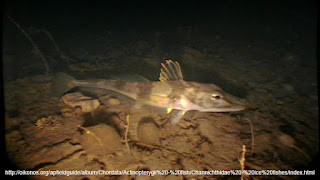
Creature 285: Chaenocephalus aceratus

Bloodless fish
Chaenocephalus aceratus is a type of antarctic ice fish, a group that dominates the freezing waters off the coast of Antarctica.

All members of this group have to be fairly well adapted for the cold and you would think that they would have to be fairly warm blooded fish. Chaenocephalus aceratus is more of a no blooded fish. It is the only vertebrate to have lost its blood. It still has a sort of translucent liquid made of of plasma pumping through its veins, but it has no blood cells and not even haemoglobin is present. Haemoglobin is the molecule vertebrates use to carry Oxygen around the body. Plasma can carry a limited amount of Oxygen, but it is only 10% as efficient.  To make up for this Chaenocephalus aceratus has an enormous heart and a higher volume of blood. This raises the question as to why they would loose rid of their blood. It doesn't give them an advantage in surviving the cold. I can't really answer that convincingly.

Distribution:
Chaenocephalus aceratus is known from a southern ocean island called Bouvet Island and from the waters around the Antarctic peninsula.

Classifications
Chaenocephalus aceratus is the only member of its genus.
Kingdom:Animalia
Phylum:Chordata
Class:Actinopterygii
Order:Perciformes
Family:Channichthyidae
Genus:Chaenocephalus
Species:Chaenocephalus aceratus

Image Links:

Sunday, 5 July 2015

Creature 278: Hemicentetes semispinosus

Cool hair

Hemicentetes semispinosus is known as the lowland streaked tenerec.


Apart from their bizarre black and yellow hairy appearance these guys have found ways to us their hair that most mammals would never think of. Their quills are essentially big thick hairs and are very useful in self defense. When this little tenerec gets scared its quills become erect and point forward. At this point the tenerec uses them as a weapon and drives them into whatever it finds threatening. Some quills are armed with little barbs to make the whole experience a little less enjoyable for whatever is hunting the tenerec. Other quills have been specially modified to make noises as they are rubbed together. These noises are used as a means of rudimentary communication, especially for instances such as a mother and child trying to find each other.


Distribution:
Hemicentetes semispinosus can only be found in Eastern Madagascar.

Classification:
Kingdom: Animalia
Phylum: Chordata
Class: Mammalia
Order: Afrosoricida
Family: Tenrecidae
Genus: Hemicentetes
Species: Hemicentetes semispinosus

Image Links:

Saturday, 27 June 2015

Creature 270: Tsintaosaurus

A suspicious horn

The Tsintaosaurus is a dinosaur with a hollow crest above its nose.

In the flesh the crest probably looked something like this:


I'll let your imagination go wild with that one. We don't really know what that horn does, although there are several theories including the possibility that they used it as some kind of noise producing horn by breathing through it.


Distribution:
Tsintaosaurus is known from eastern China and is 70 to 80 million years old.

Classification:
Kingdom: Animalia
Phylum: Chordata
Class: Sauropsida
Order: Ornithischia
Clade: Ornithopoda
Family: Hadrosauridae
Genus: Tsintaosaurus

Image Links:

Wednesday, 24 June 2015

Creature 267: Adetomyrma venatrix

Ants that drink the blood of their own babies

Adetomyrma venatrix is an ant:


It is commonly called the Dracula ant because of an unusual behavior it displays. They are hunters and orther arthropods make up the basis of their food, however adult workers can't eat solid food. If the workers get hungary they have something else to keep them going. They will take small amounts of the Haemolymph of the juvenile ants maturing in their colony. Haemolymph is not actually blood, but it is the nearest equivalent in insects. The workers won't take enough to kill them, just to keep themselves going. The juveniles do seem to mind this as they try to avoid workers when they enter the nest chambers.

This species belongs to an unusual group of ants with many characteristics which are primitive in the ant family. Their abdomen resembles a wasp. Their queens are also wingless throughout their life which is unusual in ants.

Distribution:
Dracula ants are endemic to Madagascar.

Classification:
Kingdom: Animalia
Phylum: Arthropoda
Class: Insecta
Order: Hymenoptera
Family: Formicidae
Genus: Adetomyrma
Species: Adetomyrma venatrix

Thursday, 14 May 2015

Creature 226: Myctophidae

Look at the pretty lights

Myctophidae are a family of deep sea fish known as lantern fish.

They are called lanternfish because of their tendency to light up like a lantern. As they live so far below the ocean surface that light cannot penetrate to their depth they need light patterns for sight to be useful in recognizing other members of the same species for mating. Some of these light patterns can be quite spectacular.

Lanternfish are actually quite common in the deep ocean and probably make up the majority of the fish species down there. They are known to follow a classic diel vertical migration pattern.


Distribution:
Lanternfish are found in all the world's oceans at depths of between 400 and 900 meters.

Classification:
Kingdom: Animalia
Phylum: Chordata
Class: Actinopterygii
Order: Myctophiformes
Family: Myctophidae

Image links:

Tuesday, 5 May 2015

Creature 217: Desmodontinae

Friendly blood sucking vampires
Description:
Desmodontinae is a subfamily of bats known as vampire bats.

They are called vampire bats because they love to suck your blood, and the blood of other vertebrates. They sleep in caves in large colonies during the day. If a vampire bat does not feed for a few days they are in desperate danger of starvation. Starving vampire bats have been known to beg other bats in the colony to let them feed off them. Well fed bats will usually let them. Bats which do not allow others to feed off them will find it difficult to find willing blood donors when it is their turn to do the begging.


Distribution:
Vampire bats are found in South and Central America.

Classification:
For some reason there are three genera and three species of vampire bats. I know Mammologists are weird.
Kingdom: Animalia
Phylum: Chordata
Class: Mammalia
Order: Chiroptera
Family: Phyllostomidae

Image links:

Video links:

Monday, 27 April 2015

Creature 209: Diopsidae

How to fight with your eyes
Description:
Diopsidae are a family of flies which are commonly called stalk eyed flies because their eyes protrude from their head on massive stalks.

These stalks are so prominent that their antennae are attached to to the stalk rather than the center of the head. In stalk eyed flies these eye stalks are used by males to beat off competitors in brutal eye stalk battles. Some stalk eyed flies can even inflate these stalks to scare off competitors.


Distribution:
Stalk eyes flies can be found on all continents except South America (and Antarctica). They are most commonly found in Tropical Africa and Asia

Classification:
Kingdom: Animalia
Phylum: Arthropoda
Class: Insecta
Order: Diptera
Family: Diopsidae

Image Links:

Monday, 20 April 2015

Creature 202: Eriophora

Spiders that eat their own web.
Description:
Eriophora are a genus of spiders known as garden orb weaver spiders.

All images in this post are my own work and you can use them for whatever you want if you want to use them.


Apart from the fact that they look weird many of the species of this genus have an unusual habit. Instead of leaving their web out during the day in the off chance they might catch something they tear it down and eat it. They hide inside leaves or bark in daylight hours and come out in late afternoon or twilight to spin their enormous webs all over again. Make no mistake these webs can be huge, sometimes reaching 2 meters wide.


Distribution:
Members of this genus can be found in Africa, Australia, south east Asia and the Americas. They happen to be very common in Sydney and I don't know how many times I have walked into their webs as they are spinning them around twilight.

Classification:
There are about 100 species in this diverse genus of spiders.
Kingdom:Animalia
Phylum: Arthropoda
Class: Arachnida
Order: Araneae
Family: Araneidae
Genus: Eriophora

Sunday, 19 April 2015

Creature 201: Eurypegasus draconis

A fish that sheds its skin in one piece
Description:
Eurypegasus draconis is commonly known as the Dragon sea moth, the little dragonfish or the short dragonfish.

Dragon seamoths change the color of their skin to match their surroundings, which is not exactly a unique trick but is always pretty cool. You would think that this would mean that they invest a lot in their skin which makes it valuable to the. This is not the case. They shed their skin periodically and in one piece.

Distribution:
The dragon seamoth is found in tropical Indopacific waters.

Classification:
Sea moths are a small family of fishes similar to the dragon seamoth. They are in the same order as sea horses, as you might have guessed from the shape of their head.
Kingdom: Animalia
Phylum: Chordata
Class: Actinopterygii
Order: Gasterosteiformes
Family: Pegasidae
Genus: Eurypegasus
Species: Eurypegasus draconis

Image Links:

Thursday, 2 April 2015

Creature 184: Nembrotha kubaryana

You know you like nudibranch days
Description:
It's about time we had another nudibranch, Nembrotha kubaryana. This one has a common name, the variable neon slug.

Yep, this one is green and black. Those two thongs which look like alien antennae are actually its gills.

Like many of the other nudibranches, this one defends itself by using toxins in the prey it eats. In this case they feed on various toxic sea squirts and excrete a mucous full of poison in the direction of anything which it scares it.

Distribution:
Nembrotha kubaryana is found in tropical waters in the Indian and West Pacific Oceans.

Classification:
Kingdom: Animalia
Phylum: Mollusca
Class: Gastropoda
Order: Nudibranchia
Family:  Polyceridae
Genus: Nembrotha
Species: Nembrotha kubaryana

Image Links: