Showing posts with label Cool predator. Show all posts

Saturday, 12 September 2015

Creature 347: Powelliphanta


Slimy yet satisfying
Powelliphanta is a genus of carnivorous landsnails known as the New Zealand amber snail.
Powelliphanta lignaria johnstoni, Charming Creek, West Coast. Photo: Jess Reedy.
They love to eat earthworms. They don't just eat them either, they slurp them up like spaghetti.  Watch it here:


Distribution:
The New Zealand amber snails are unsurprisingly endemic to New Zealand. Most species have a very limited geographic range.

Classification:
Kingdom: Animalia
Phylum: Mollusca
Class: Gastropoda
Order: Heterobranchia
Family: Rhytididae
Genus: Powelliphanta

Image Links:

Video Links:

Friday, 4 September 2015

Creature 339: Phymatinae


Surprise!

It's about time we had another assassin bug, considering it has been a while since the last and after all an assassin bug is the most viewed post on my blog.

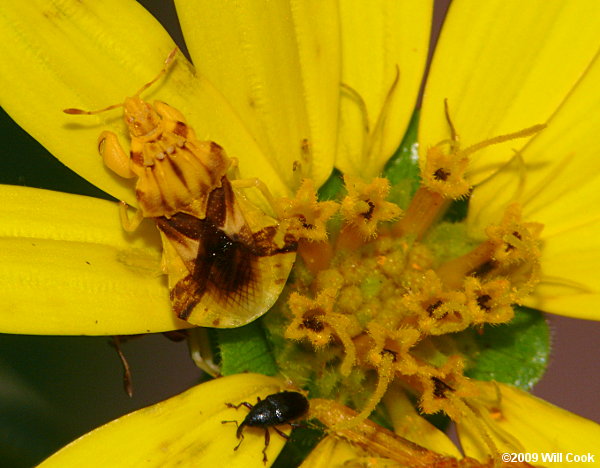
Ambush Bugs (Phymatinae)

Phymatinae are a subfamily of assassin bugs commonly known as ambush bugs. Their speciality is camouflage and surprise attack on their prey. Their heavily armed raptorial forelegs and curved piercing rostrum enable them to take down prey which can get up to ten times larger than them.

Female Ambush Bug feeding on a Bumble Bee

Distribution:
Ambush bugs can be found anywhere,  but are most common bin tropical regions of Asia and the Americas.

Classification:
Kingdom:Animalia
Phylum:Arthropoda
Class: Insecta
Order: Hemiptera
Family: Reduviidae

Image Links:

Tuesday, 14 July 2015

Creature 287: Meloe

A beetle or an STD?

Meloe is a genus of beetle which can be called oil beetles or blister beetles.

These beetles can be considered parasitic, but really they are just very clever predators and scavengers. Each species of Meloe is highly specialized to hunt bees of a particular species or a few closely related species. Juvenile Meloe beetles form large clumps of worms which roughly approximate the shape of a female bee. They then all emit pheromones which mimic those of female bees of the particular species they are hunting. The unsuspecting males which fly by will approach and be disappointed, however unharmed. The juvenile beetles only want to attach themselves to the unsuspecting male bee. Hopefully he will then find a real female bee and the juvenile beetles will transfer over. When the female eventually returns to her hive the beetles will infest it and feed off the honey and the defenseless juvenile bees.

This site has a good video of the whole process:

As adults most species of Meloe are completely flightless. Despite the horror movie like childhood the adults live on flowers and only eat pollen. When they are attacked (or picked up) they drip a toxic oily substance which can cause blistering on the skin.


Distribution:
Meloe can be found throughout the Americas and the Palaerctic region.

Classification:
Kingdom: Animalia
Phylum: Arthropoda
Class: Insecta
Order: Coleoptera
Family: Meloidae
Genus: Meloe

Image Links:

Video links:

Monday, 15 June 2015

Creature 258: Livyatan melvillei

What big teeth you have!

As a rule among modern whales,  the big ones are friendly and feed on plankton and the smaller ones like killer whales are hunters, feeding mostly off fish. If Livyatan melvillei was still alive it would be an exception to this rule.


Livyatan melvillei grew to 17.5 meters long, a little smaller than a blue whale or sperm whale but definitely one of the big ones. It's skull measured up to 3 meters long and its teeth got up to 36 cm in length. These are the largest teeth that work as teeth of any known animal ever.


So what did it need such big teeth for? It used to hunt and kill other whales! Other than humans whales have not really had many predators in their history so that makes Livyatan melvillei part of a very small club. Sperm whales are also large hunters but their primary food source is large squids and not other whales.

Distribution:
Livyatan melvillei lived 12-13 million years ago and were found not far off the west coast of Peru.

Classification:
Livyatan is a monotypic genus and its familial placement is uncertain. They are large toothed whales belonging to the superfamily Physeteroidea with sperm whales but for now they have not been designated a family.

Kingdom: Animalia
Phylum: Chordata
Class: Mammalia
Order: Artiodactyla
Family: incertae sedis
Genus: Livyatan
Species: Livyatan melvillei

Image Links:

Thursday, 11 June 2015

Creature 254: Arthrobotrys oligospora

The fungus that watches and waits

Arthrobotrys oligospora is a fungus and like other fungi it likes to break down organic matter.


These guys like to feed on small animals, particularly nematode worms. They are not their only source of food, but they are a good source of nitrogen. It might sometimes be hard to find dead nematodes so these guys are a little more proactive. Their hyphae form little sticky rings which constrict when a nematode comes across them, much like a snare we might use for animal trapping. The fungus will then grow its hyphae into the nematode and absorb all the nutrients out of its body.


But these fungi don't always lay down these snares. They can detect when there are nematodes around by the chemicals present on the skin of the nematodes. In the presence of nematodes the fungus will build snares.  When there are no nematodes around they feed off other thing, but they are always watching and waiting for nematodes.

Distribution:
Arthrobotrys oligospora is a wide ranging species and from what I can tell they are probably cosmopolitan.

Classification:
Kingdom: Fungi
Phylum: Ascomycota
Class: Leotiomycetes
Order: Helotiales
Family: Orbiliaceae
Genus: Arthrobotrys
Species: Arthrobotrys oligospora

Thursday, 16 April 2015

Creature 198: Varanus komodoensis

A deadly lizard
Description:
Varanus komodoensis is a monitor lizard known as the Komodo dragon.

Growing up to 3 m in length and weighing up to 70 kg they are the largest living lizard.  They are predators and feed mostly on deer which they hunt. The Komodo dragon can sprint at speeds speeds of up to 20 km/h but a single one may struggle to keep up with a quick agile deer if it does not catch them by surprise. That is why Komodo dragons, unlike any other snake or lizard,  will cooperate whole hunting.  They are also armed with anticoagulants in their bite to prevent prey from running too far if they are bitten. They may have other poisons in their bite.

The Komodo dragon will occasionally attack and eat humans if given the opportunity.

Distribution:
The Komodo dragon can only be found on a few islands of the Lesser Sunda islands,  Indonesia especially the island called Komodo. Fossil records may indicate that they were once more wide spread.

Classification:
Kingdom: Animalia
Phylum: Chordata
Class: Sauropsida
Order: Squamata
Family: Varanidae
Genus: Varanus
Species: Varanus komodoensis

Wednesday, 15 April 2015

Creature 197: Solaster dawsoni

Star wars.
Description:
Solaster dawsoni is a sea star which is usually referred to as the morning sun star, which is a silly name because the sun is a star.

This sea star is interesting in that it specializes in eating other sea stars. It will even eat other members of its own species. They are so good at eating other sea stars that many sea stars whose distribution overlaps with the morning sun star have evolved defence mechanisms. These range from fleeing the second they make contact to fighting back with pincers or slime. You can watch one of these slow motion battles here:


Distribution:
Solaster dawsoni  is found on continental shelf of the north Pacific ocean.
Classification:
Kingdom: Animalia
Phylum: Echinodermata
Class: Asteroidea
Order: Velatida
Family: Solasteridae
Genus: Solaster
Species: Solaster dawsoni

Image Links:

Video Links:

Wednesday, 1 April 2015

Creature 183: Thylarctos plummetus

Cuddly carnivores
Description:
Thylarctos plummetus is an Australian Marsupial commonly referred to as a drop bear:


They weigh about 120 kg and grow to about 130 cm  in length. They are large predatory marsupials whose closest living relative is the Koala, and like Koalas they are found almost exclusively in Eucalyptus trees. Unlike their Eucalyptus feeding cousins, they are carnivorous and have a rather unique hunting strategy. They are ambush predators, and like the Koala they wait around in their tree for a long time. While they are waiting, their metabolic rate reduces dramatically. Their fur is modified to camouflage particularly well in the particular blue-green tint of Eucalyptus trees. When an unwitting prey item wanders underneath the tree in search of a rest in the shade this ferocious predator will drop from the branches above. The shock of the impact of the heavy animal will often stun or knock out their prey at which point they use their fangs to puncture the arteries in the neck, killing their prey before it recovers. They will then slowly devour their prey. If the prey is large they will return to their tree and sleep while they digest their meal and then return to the ground to finish off what is left. It is believed this behavior led to the possibility of evolving into a low energy diet such as that of a Koala. It is also believed that the scarcity of prey in the sparse, dry Australian Eucalyptus forests led to the necessity of evolving to exploit an alternative, more abundant food source, namely Eucalyptus leaves. Drop bear will occasionally attack humans and there are a few accounts of survivors of such attacks however we are unsure how common fatal attacks are as drop bears will not leave any remains after a few days of feeding and they usually so not attack groups, but only individuals on their own.

There are many urban legends as to what attracts or repels drop bears such as Vegemite, urine and Australian accents. Most if not all of these are probably false, however many people still take such precautions in areas with a high risk of drop bear attack, just in case. It is statistically more likely that tourists will be attacked by drop bears than Australian, but this is probably due to the fact that tourists are unaware of the dangers and if they see a drop bear they will be more likely to confuse it for a Koala and try to get close for a good look. Photos of Drop bears are rare as people tend to keep moving in drop bear infested areas which greatly reduces the chance of attack.

Distribution:
Their distribution is patchy, while they are most concentrated on the east cost of Australia their full distribution is best described visually.
The Australian Museum website have the most accurate distribution map.

Classification:
Drop bears are not true bears, but are marsupials. While their closest living relative is the koala and the external appearance is fairly similar the two species are more different than a first glance would reveal. The drop bear has a lot more muscle mass, a much simpler digestive tract and and a much more highly developed brain than a Koala.
It is a subject of much controversy as to whether the most recent ancestors of Koalas and drop bears are carnivorous or herbivorous. I tend to favor the carnivorous hypothesis. The Koala's morphology shows evidence of simplification in the brain and in certain muscles it is believed that the koala may have evolved from a carnivorous ancestor rather than a herbivorous one. It seems fairly likely that Koalas have fairly recently evolved to become accustomed to a Eucalyptus diet and that is why they are not born with the stomach bacteria necessary to digest Eucalyptus leaves, but need to eat their mother's feces early on in life to acquire the appropriate gut microbes.

Kingdom: Animalia
Phylum: Chordata
Class: Mammalia
Order: Diprotodontia
Family: Phascolarctidae
Genus: Thylarctos
Species: Thylarctos plummetus

Image Links:
http://www.australiangeographic.com.au/news/2013/03/drop-bears-target-tourists,-study-says/
http://australianmuseum.net.au/uploads/comments/18460/dropbear1.jpg

Monday, 30 March 2015

Creature 181: Sphyrna

But did you know they could tan?

Description:
You can't have a bizarre creature blog without, at some point, including Sphyrna, the hammerhead shark.

Hammerhead sharks earn their name because their head has been laterally elongated to create a wide gap between their eyes. This gives them several sight related advantages including the ability to see 360 ° along the vertical axis.


Like other sharks they are capable of detecting electromagnetic fields. They use this ability to hunt animals living in the sand on the ocean floor.  They sweep their head from side to side along the ocean floor in order to detect any prey which might be hiding.  Apart from that, they are capable of getting a tan if they are exposed to a lot of sunlight.

Distribution:
Hammerhead sharks are known from shallow coastal waters all over the world.

Classification:
There are 9 hammerhead shark species in the genus Sphyrna.
Kingdom: Animalia
Phylum: Chordata
Class: Chondrichthyes
Order: Carcharhiniformes
Family: Sphyrnidae
Genus: Sphyrna

Image Links:

Friday, 27 March 2015

Creature 178: Trilophosuchus rackhami

A (thankfully) extinct crocodillian
Description:
Trilophosuchus rackhami is a member of an extinct group of crocodiles.

Crocodillians are probably some of the scariest ambush predators in the world, they are very efficient killers and have had the same basic body plan and hunting strategy for hundreds of millions of years. Fortunately all living are aquatic, and avoiding them is a simple matter of avoiding the water in which they live. Image, however that there was a crocodillian that lived in trees. Certain aspects of the skeleton of Trilophosuchus rackhami indicate that it was terrestrial, and possibly even arboreal, all though not all paleontologists agree. Walking through a dark forest would be a lot more scary if there were crocodiles in the trees waiting to spring out and ambush you on the ground.

Distribution:
Trilophosuchus rackhami is only known from the Riversleigh deposits in North Queensland and are Miocene in age.

Classification:
Trilophosuchus rackhami is the only member described in the genus Trilophosuchus.
Kingdom: Animalia
Phylum: Chordata
Class: Sauropsida
Order: Crocodilia
Family: Crocodilidae
Genus: Trilophosuchus 
Species: Trilophosuchus rackhami

Image Links:
http://en.wikipedia.org/wiki/Trilophosuchus

Sunday, 22 March 2015

Creature 173: Archaeidae

This spider only eats other spiders.
Description:
Archaeidae are a family of spiders which are commonly known as assassin spiders or pelican spiders.


Their fangs (actually Chelicera) have been grossly elongate and there is a large neck like elongation on their cephalothorax which give them their weird pelican like look. These adaptions are specifically designed to give then a fast strike with a long reach, a huge advantage when they are hunting the particular prey that they specialize on. The victims of these bizarre species are, in fact, other spiders. They hunt other spiders by following the web trails that spiders leave behind as they walk around. They are able to move across the web of other spiders without being detected or to pluck the web to coax the other spider to attack them. They impale their prey on one of their massive fangs and let them slowly die on the end of the fang before they eat them.


Distribution:
Archaeidae are found in South Africa, Madagascar in various disjunct regions of Australia. They are an ancient taxon with the fossil record going back to 40 million years age, and the age of the group probably going back much further than that.

Classification:

The family Archaeidae only contains 4 genera and  about 20 known species.
Kingdom: Animalia
Phylum: Arthropoda
Class: Arachnida
Order: Araneae
Family: Archaeidae

Image Links:

Monday, 16 March 2015

Creature 167: Dorylus

Ants that really hold a grudge.

Description:
Dorylus is a genus of army ants which are commonly called driver ants.

They are omnivorous,  highly aggressive and highly territorial. If you ever disturb one of their nests, run. I mean it. They will quickly swarm anything which they percieve to be a threat and will tear it appart and eat it. Driver ant colonies can contain literally millions of individual ants, so don't assume you are safe just because they are tiny. They are also very deternmined and when they bite a percieved threat they can lock their jaws. When they do this they are very hard to remove and their jaw will remain locked even if you tear ther thorax off the head. This bite is so strong that some indigenous peoples use them to suture wounds.

When their colony is running out of food they form large swarms which sometimes contain tens of thousands of ants. Theae swarms slowly move away from the nest devouring everthing in their path before returning. A single driver ant has nothimg on a fire ant or a bullet ant in terms of the pain and damage they can inflict, but their entire colonies are so quick to respond to any threat that they arw probably the most dangerous ants on earth.

Distribution:
Various species of driver ants can be found in Tropical Africa and Asia

Classification:
Kingdom: Animalia
Phylum: Arthropoda
Class: Insecta
Order: Hymenoptera
Family: Formicidae
Genus: Dorylus

Image Links:

Tuesday, 10 March 2015

Creature 161: Reduvius personatus

The masked hunter.

Today's creature, Reduvius personatus, is an assasin bug which are one of my favorite families.  They are called assassin bugs because of their cool tricks for hunting and killing their prey. A lot of all the assassin bugs in my blog should be included under the Hemiptera label.

Description:
Reduvius personatus are commonly known as bed bug assassins, masked bed bug hunters or masked hunters, which is a really cool sounding name. And they earned it.


Masked hunters hunt small arthropods, mostly insects. They are quite versatile in their prey selection and in the environments in which they hunt. This is because of their cool camouflage.  Many insects and spiders camouflage well in a particular environment or on a particular plant because they have evolved to blend in with those particular surroundings. This strategy works for specialist predators,  but if you want to hunt a variety of prey like the masked hunter does you need something more generic. Juvenile masked hunters excrete a glue like substance, much like Acanthapsis petax. This causes the dirt and dust from the surrounding environment to stick to them, forming a 'mask' and camouflaging them in whatever environment they are in.


The association with bed bugs in some of their common names is no coincidence. They are often seen in urban environments hunting bed bugs and while they are not bed bug hunting specialists they are very good at it. Masked hunters will bite humans if they are handles. Their bite is painful but harmless.


Distribution:
Masked hunters have a Holarctic distribution but their presence in North America is a result of a human introduction.

Classification:
Kingdom: Animalia
Phylum: Arthropoda
Class: Insecta
Order: Hemiptera
Family: Reduviidae
Genus: Reduvius
Species: Reduvius personatus

Image Links:

Wednesday, 4 March 2015

Creature 155: Argyroneta aquatica

Spider with underwater houses
Description:
Argyroneta aquatica is commonly called the diving bell spider.


All spiders need to breath air, but some spiders can survive for a while underwater due to a really cool trick. Spider 'hairs' (really called setae) are hydrophobic which enables some spiders to surround themselves in a bubble of air and and swim underwater. Diving bell spiders are unique mostly because of their habit of living almost entirely under water. They construct bell shaped webs which they anchor to the floor of a stagnant body of water. This bell is full of air and serves as a home base. Diving bell spiders also carry large bubbles of air between their legs.  When oxygen levels are low they take a trip to the surface and get a refill.


Occasionally they leave their bell to catch small prey items which run into their submarine home. When males are mature they build a bell web on the side of a female's bell webs and tunnel into her home to breed. The female lays the eggs inside her bell and the offspring are born underwater.


Distribution:
Diving bell spiders inhabit stagnant water sources in the palaerctic region.

Classification:
Kingdom: Animalia
Phylum: Arthropoda
Class: Arachnida
Order: Araneae
Family: Cybaeidae
Genus: Argyroneta
Species: Argyroneta aquatica

Image Links:

Monday, 23 February 2015

Creature 146: Berghia coerulescens.

Eat a lump of cold poison

This post was accidentally released early the other day, but there can't be 2 bizarre creatures of the day so it was taken down almost immediately and is being posted today. Today's creature is a Nudibranch, and is here  mostly because it looks weird.

Description:
I feel like I have talked about how weird Nudibranches are in my other two nudibranch posts but its bizarre appearance alone entitles it to a post on this blog.

Like Glaucus atlanticus this species eats Cnidarians, which are nasty poisonous stinging things in general. The poison they consume is stored in those spectacularly colorful finger like processes on their back and used as a defense.


Distribution:
Berghia coerulescens is found in the Northern Atlantic Ocean and the Caribbean close to the shores and unusually less than 1 m below the surface of the water.

Classification:
Kingdom: Animalia
Phylum: Mollusca
Class: Gastropoda
Order: Nudibranchia
Family: Aeolidiidae
Genus: Berghia
Species: Berghia coerulescens

Sunday, 22 February 2015

Creature 145: Paratarsotomus macropalpis

The fastest land animal in the world (ish)
Description:
Paratarsotomus macropalpis is a mite, and not really a particularly interesting looking mite at that.


This little guy does not even reach 0.1 mm in length, which is not all that unusual for a mite. Mites are not the fist animal you think of in a discussion on speech, but these little guys are the fastest land animal on earth. O.K. I should probably qualify that statement.  It is the fastest land animal if you use body lengths per second as a measure of speed, in other words it is the fastest land animal relative to its size. If you're a physicist,  you are probably complaining that this is cheating and you cant have a unit of measurement which changes depending on what you are measuring.  I say that the physicists are being boring. So how fast is it? They have been measured reaching speeds of 322 body lengths per second taking up to 135 strides per second. This only equates to 0.225 meters per second, but a human travelling are 322 body lengths per second would have to be going around 2000 kilometers per hour.

This little mite doesn't mind the heat comfortably running on surfaces of up to 60 degrees Celsius. It is believed that it moves so quickly in order to hunt its prey, however we are not entirely sure what they eat as they are understandably difficult to observe in nature.

Distribution:
Paratarsotomus macropalpis are native to Southern California.

Classification:
Kingdom: Animalia
Phylum: Arthropoda
Class: Arachnida
Order: Trombidiformes
Family: Anystidae
Genus: Paratarsotomus
Species: Paratarsotomus macropalpis

Image Links:

Thursday, 19 February 2015

Creature 142: Misumena

This species changes color to hide

Description:
Misumena is a genus of spiders commonly known as the flower crab spider. 

Spiders are the ultimate ambush predators, they are patient and don't need to eat very often. They posses sticky web to subdue their prey and potent venom which can knock out their prey quickly enough to prevent a fight. They just need a way of getting close. These spiders have used their preys greatest weakness to force them to get close. They feed on the insects that come to pollinate the flowers that they live on. Their spectacular coloration is a form of camouflage so their prey will never suspect that they are waiting in ambush.

There are many different species with various color patterns which are specifically adapted to blend in to the flowers with which they have co evolved. Some species can even change colors to blend into different flower species.


Distribution:
Misumena have a Pantropical distribution.

Classification:
Kingdom: Animalia
Phylum: Arthropoda
Class: Arachnida
Order: Araneae
Family: Thomisidae
Genus: Misumena 

Image Links:


Thursday, 12 February 2015

Creature 135: Mastigoproctus giganteus

Acid spraying scorpion-like predator

Description: 
Mastigoproctus giganteus  or the giant Vinegarroon is a species of whip scorpions, with a rather frightening appearance:

It is the largest whip scorpion, growing up to 85 mm long. Like other whip scorpions their front pair of legs has been modified into a long and slender jointed appendage which is very sensitive. They use them to feel their way around like a pair of antennae. Their whip like tail is mostly for sensory purposes, they use a different method to kill their prey. The base of their tail sprays vinegar over their prey in order to disable them. Only this vinegar is far more concentrated than normal vinegar with concentrations reaching 85% acetic acid.

The females lay large eggs (for arthropods) in a sealed egg sac which they carry with them. When their young hatch they carry them around on their abdomen. They are slow growing organism, taking around 2 years to reach maturity.


Distribution:
The giant Vinegarroon is found in Mexico and Southern United States.

Classification: 
Whip scorpions are arachnids but are neither spiders or scorpions. Their tail is homologous with the stinging tail of a scorpion. Their closest relatives are the camel spiders, which are also arachnids, and also neither spider or scorpions.

Kingdom: Animalia
Phylum: Arthropoda
Class: Arachnida
Order: Thelyphonida
Family: Thelyphonidae
Genus: Mastigoproctus
Species: Mastigoproctus giganteus

Image Links:
http://www.thedauphins.net/rgv_arthropods.html
http://madrean.org/symbfauna/collections/individual/index.php?occid=252912
http://en.wikipedia.org/wiki/Mastigoproctus_giganteus

Thursday, 5 February 2015

Creature 128: Hymenopus coronatus

Mimicking a mimic
Description:
Hymenopus coronatus is commonly known as an orchid mantis. You have seen orchids that mimics
insects, now take a look at this predator which takes advantage of these relationships.


The strategy is ingenious. Orchids have spent millions of years evolving to be incredibly good at attracting their insect pollinators. I have posted about a couple of orchids, you can see them here. In the process they have inadvertently become the perfect place for an ambush predator. The Orchid mantis has modified its body so that it camouflages into Orchid flowers. They can wait for the flower to attract the pollinators and gobble them up. All the while their camouflage protects them from predators. They are capable of changing the markings on their body depending on the flower they are camouflaging against.


Male orchid mantises can be less than half the size of Females, and considering that female mantises tend to eat the males after mating this is very bad news for the males. The juveniles resemble juvenile assassin bugs, which are not palatable to most predators and can use their tubular rostrum to inflict pain on their predators (Or entomologists who try to catch them). If you want to know more about assassin bugs you can read about a couple of species here and here. There are more coming.


Distribution:
Orchid mantises are endemic to the Oriental bioregion.

Classification:
I use the modern classification of Dictyoptera for the old orders Mantodea, Isoptera and Blattodea as recent analyses have shown that Isoptera are nested within Blattodea, and while Mantodea and the Blattodea-Isoptera complex are considered to be monophyletic the strength of these relationships are not particularly strong, although they certainly all form a monophyletic group together.


If this is all gibberish to you and you have a few minutes you can read this page. Or you could just look at the pretty pictures of the Orchid mantis and not think about the possibility that they are closely related to cockroaches and termites.

Kingdom: Animalia
Phylum: Arthropoda
Class: Insecta
Order: Dictyoptera
Family: Hymenopodidae
Genus: Hymenopus
Species: Hymenopus coronatus

Image Links:
http://tulipsbreaking.blogspot.com.au/
http://photorator.com/photo/9118/blue-orchid-mantis-hymenopus-coronatus-
http://rhyssharry.blogspot.com.au/2014/03/mimic-spotlight-orchid-mantis-hymenopus.html

Wednesday, 28 January 2015

Creature 120: Pepsini

This insects hunts tarantulas
Description:
Many people are scared of spiders, especially large hairy spiders like tarantulas such as the Goliath Bird eater which I posted the other day. Their frightening appearance leads some people to assume that they are the most ferocious predators in the Arthropod world. This is not the case. Spiders are just the helpless prey of the pompilid wasps. Even Tarantulas had better flee for their lives in the presence of members of the pompilid tribe Pepsini, commonly known as tarantula hawk wasps.

Like the Cockroach wasps these flying horrors like to lay their eggs in a nest with their prey stored inside it. Also like the cockroach wasps their victims are still alive while they are being eaten by the juvenile wasps. However these guys don't use the same really cool mind altering zombification as the cockroach wasps. Their sting is a potent paralytic in the tarantulas that they victimize. They then use brute strength to drag the tarantula into the nest and seal it off after laying a single egg inside. You can imagine what happens to the tarantula then, and if you need a hint, it is not pleasant.

In humans their sting is short lived but incredibly painful. It is one of only two groups to achieve the highest category of 4 in the Schmidt pain index, with victims claiming that the pain is so bad that it will cause the victim to temporarily lose control of themselves. They are not particularly aggressive towards humans, but if you play around with them they will not hesitate to sting you. The state of New Mexico has adopted a Tarantula Hawk Wasp as their state insect. I think everyone should have a state insect. Their body is variously colored depending on the species and in some cases they can be quite spectacular.


Watch it all happen here:


Distribution:
Pepsini have a pantropical distribution spilling over into some temperate areas, especially in the Americas where there are plenty of tarantulas to go around..

Classification:
There are only two genera in the tribe Pepsini, Pepsis and Hemipepsis.
Kingdom: Animalia
Phylum: Arthropoda
Class: Insecta
Order: Hymenoptera
Family: Pompilidae
Tribe: Pepsini

Image Links:
http://markcorder.com/home/pepsis-prey-tarantula-hawk/
http://commons.wikimedia.org/wiki/File:Wasp_with_Orange-kneed_tarantula.JPG
https://mylandrestorationproject.wordpress.com/tag/tarantula-hawk/

Video Links:
https://www.youtube.com/watch?v=AqsHVLy9s1M