Showing posts with label Arachnida. Show all posts

Friday, 11 September 2015

Creature 346: Anelosimus eximius


It's raining spiders
Anelosimus eximius is a species of colonial spiders.
Much like Tetragnatha guatemalensis they form large colonies which can contain thousands or even tens of thousands of individuals. This behaviour enables them to capture much larger prey items than other spiders of roughly the same size. Colonies can cover several square meters among tree canopies.

Given that a single female can lay dozens of eggs and that there are usually ten females for ever male in a colony, there can often be incredibly large numbers of juveniles hatching in a single colony. The juveniles disperse through the wind, like a lot of spiders and when the juveniles of a large colony hatch it can lead to a situation in which it appears to be raining spiders.

Distribution:
Anelosimus eximius can be found in South and Central America.

Classification:
Kingdom:Animalia
Phylum:Arthropoda
Class:Arachnida
Order:Araneae
Family:Theridiidae
Genus:Anelosimus
Species: Anelosimus eximius

Image Links:

Video Links:
https://www.youtube.com/watch?v=vN9mQk8N5Mo

Sunday, 30 August 2015

Creature 334: Ixodes holocyclus


A scary tick

Ixodes holocyclus is commonly known as the paralysis tick.

Tick before and after feeding.jpg

Paralysis ticks will usually not usually cause serious side effects in humans, but on occasion the neurotoxin they produce can cause serious symptoms which are similar to anaphylaxis. It can also cause muscle weakness, which if the tick is not removed will eventually progress to full blown paralysis. In extreame cases the tick can kill its host.

Distribution:
Paralysis ticks can be found along the east coast of Australia between the ocean and the great dividing range.

Classification:
Kingdom: Animalia
Phylum: Arthropoda
Class: Arachnida
Order: Acari
Family: Ixodidae
Genus: Ixodes
Species: Ixodes holocyclus

Image Links:
https://en.wikipedia.org/wiki/Ixodes_holocyclus

Tuesday, 28 July 2015

Creature 301: Thwaitesia argentiopunctata

A reflective spider
Thwaitesia argentiopunctata is commonly known as the mirror spider.

It gets this name from the reflective patches on their abdomen, which resembles little mirrors. The little mirrors grow larger when they feel threatened.


Distribution:
The mirror spider is found all over Australia.

Classification:
Kingdom: Animalia
Phylum: Arthropoda
Class: Arachnida
Order: Araneae
Family: Theridiidae
Genus: Thwaitesia
Species: Thwaitesia argentiopunctata

Image Links:
https://en.wikipedia.org/wiki/Thwaitesia_argentiopunctata
http://whatthefauna.tumblr.com/post/97884942339/the-sequined-or-mirror-spider-has-silvery

Sunday, 19 July 2015

Creature 292: Holconia

An excuse to post some of my own photos. 


Holconia is a genus of huntsman spider.

Images in this post are my own. You can use them for whatever you want.

Actually I'm not 100÷ sure I got this ID right, but I'm pretty confident this I Holconia, probably Holconia immanis as I found it in Sydney.


There isn't anything that special about these guys, they are big and scary looking but I really just wanted to post some of my photos on the blog.


Distribution:
Holconia are found throughout Australia. The species H. Immanis is found on the East coast.

Classification:
Kingdom: Animalia
Phylum: Arthropoda
Class: Arachnida
Order: Araneae
Section: Entelegynae
Family: Sparassidae
Genus: Holconia

Friday, 10 July 2015

Creature 283: Avicularia versicolor

Big hairy tarantulas can be pretty too

Avicularia versicolor is a big hairy tarantula, but before you judge it as ugly take a look:

It is commonly known as the Antilles pink toed tarantula. It lives in deep funnel webs inside trees. The juveniles are born with a radically different coloration to the adults and colour changes gradually as they mature.

Distribution:
Avicularia versicolor is native to a few Carribean Islands.

Classification:
Kingdom: Animalia
Phylum: Arthropoda
Class: Arachnida
Order: Araneae
Family: Theraphosidae
Genus: Avicularia
Species: Avicularia versicolor

Image Links:

Tuesday, 9 June 2015

Creature 252: Bagheera kiplingi

The hippie spider

Bagheera kiplingi
is a salticid (jumping spider) which as far as I know doesn't have a common name. I like to call it the hippie spider for reasons which will become clear soon.

A lot of people find spiders to be creepy even though they look really cool and are mostly harmless to humans. To be fair to all those who get creeped out by spiders, they are creatures who as a rule like to ambush and entrap other animals, subduing them with sticky silk and venom. Once subdued they slowly digest their prey alive and suck the partially digested body fluids out with massive fangs. That is sort of creepy. Bagheera kiplingi, however does not follow rules.  These little nonconformists feed off the Beltian bodies of plants, which are intended to be enticements for ants to protect the plant from herbivorous insects. As jumping spiders they posses the agility to evade the hordes of ants protecting their food source and snatch up the occasional meal.


Distribution:
Bagheera kiplingi  is endemic to Central America.

Classification:
Kingdom: Animalia
Phylum: Arthropoda
Class: Arachnida
Order: Araneae
Family: Salticidae
Genus: Bagheera
Species: Bagheera kiplingi

Image Links:

Tuesday, 2 June 2015

Creature 245: Poltys illepidus

Lurking on the trees

Poltys illepidus is a spider with a pretty cool camouflage.


Commonly known as the tree stump Orb-weaver due to its uncanny ability to blend in while hiding on a tree stump. If you don't look closely it looks like a lump on the tree. It remains perfectly motionless during the day and comes out to spin its web at night. It is quite a common species but is very good at hiding and most of the time you won't know it is there. The good news is they are not aggressive and their venom is harmless to humans.


Distribution:
This species has been recorded from North Queensland, Australia to continental South East Asia.

Classification:
Kingdom: Animalia
Phylum: Arthropoda
Class: Arachnida
Order: Araneae
Family: Araneidae
Genus: Poltys
Species: Poltys illepidus

Sunday, 31 May 2015

Creature 243: Liphistiidae

Description:
Liphistiidae are a family of spiders which don't have a common name.

These spiders are remarkable because they remain morphologically very similar to 290 million year old fossils from the same suborder. This means they have a very highly conservative body plan. Their venom glands are tiny and for a while biologists believed they didn't have them. They lack parts of the respiratory system which are present in all other spiders. They live in tiny tube-like borrows and make use of trapdoors like many other spiders. 

Over the last 300 million years they have really got the whole trapdoor technique down packed.

Distribution:
Liphistiid spiders are found in East and South East Asia.

Classification:
Liphistiidae have been placed in a spider suborder called Mesothelae and are the only living spiders in this group. There are 3 extinct members of this group, all of which have a fairly highly conserved morphology. This suborder is the most basal group of spiders (i.e. it is the most distant relative of all other species of spiders). There are 8 genera in the family.
Kingdom: Animalia
Phylum: Arthropoda
Class: Arachnida
Order: Araneae

Image Links:
http://en.wikipedia.org/wiki/Liphistiidae
http://www.qldaf.com/forums/spiders-insects-invertebrates-photo-video-lounge-95/liphistius-most-primitive-spiders-alive-76343/

Video Links:
https://www.youtube.com/watch?v=e3sDJnqj7hY

Monday, 11 May 2015

Creature 223: Tetragnatha guatemalensis

A cobweb problem
Description:
Tetragnatha guatemalensis is a species of spider which, as far as I know, doesn't have a common name.

They are a species of spider which commonly live in large colonies. I  there colonies several different spiders build communal 'sheet' webs, often adding constructing webs between two other webs. The strength of structural spider webs mean that these communal webs can get quite large.


They are by no means the only species of spider which does this, but these guys have set a record. In October 2009 a waste water treatment plant in Baltimore was over-run by an enormous colony of spiders. The colony had formed a variety of structures reinforcing a colonial web which was found throughout the 4 acre facility. There were an estimated 107 million spiders in the colony and an estimated 80 million of them were Tetragnatha guatemalensis. There are around 6 million people in the entire state of Maryland.

Distribution:
Tetragnatha guatemalensis can be found in various locations across North and Central America. They love man made structures.

Classification:
Kingdom: Animalia
Phylum: Arthropoda
Class: Arachnida
Order: Araneae
Family: Tetragnathidae
Genus: Tetragnatha
Species: Tetragnatha guatemalensis

Image Links:

Monday, 20 April 2015

Creature 202: Eriophora

Spiders that eat their own web.
Description:
Eriophora are a genus of spiders known as garden orb weaver spiders.

All images in this post are my own work and you can use them for whatever you want if you want to use them.


Apart from the fact that they look weird many of the species of this genus have an unusual habit. Instead of leaving their web out during the day in the off chance they might catch something they tear it down and eat it. They hide inside leaves or bark in daylight hours and come out in late afternoon or twilight to spin their enormous webs all over again. Make no mistake these webs can be huge, sometimes reaching 2 meters wide.


Distribution:
Members of this genus can be found in Africa, Australia, south east Asia and the Americas. They happen to be very common in Sydney and I don't know how many times I have walked into their webs as they are spinning them around twilight.

Classification:
There are about 100 species in this diverse genus of spiders.
Kingdom:Animalia
Phylum: Arthropoda
Class: Arachnida
Order: Araneae
Family: Araneidae
Genus: Eriophora

Sunday, 22 March 2015

Creature 173: Archaeidae

This spider only eats other spiders.
Description:
Archaeidae are a family of spiders which are commonly known as assassin spiders or pelican spiders.


Their fangs (actually Chelicera) have been grossly elongate and there is a large neck like elongation on their cephalothorax which give them their weird pelican like look. These adaptions are specifically designed to give then a fast strike with a long reach, a huge advantage when they are hunting the particular prey that they specialize on. The victims of these bizarre species are, in fact, other spiders. They hunt other spiders by following the web trails that spiders leave behind as they walk around. They are able to move across the web of other spiders without being detected or to pluck the web to coax the other spider to attack them. They impale their prey on one of their massive fangs and let them slowly die on the end of the fang before they eat them.


Distribution:
Archaeidae are found in South Africa, Madagascar in various disjunct regions of Australia. They are an ancient taxon with the fossil record going back to 40 million years age, and the age of the group probably going back much further than that.

Classification:

The family Archaeidae only contains 4 genera and  about 20 known species.
Kingdom: Animalia
Phylum: Arthropoda
Class: Arachnida
Order: Araneae
Family: Archaeidae

Image Links:

Sunday, 15 March 2015

Creature 166: Tyrophagus casei

Gourmet mites
Description:
Tyrophagus casei is a species of mite referred to as a cheese mite, although it is not the only mite to carry this common name.

This creature is not really all that bizarre,  but what we do with them is. These little mites are well adapted to survive in domestic environments.  They are scavengers and will eat a lot of what we eat such as cheese, smoked meats and flour. It is their taste for cheese which makes them of particular interest. 

They are not called cheese mites simply because they like to eat cheese but because they are uses to produce cheese, specifically a gourmet German cheese known as Milbenkäse. The cheese mites will rapidly colonize the outer layer of the cheese. As they eat, they defecate and they grow shedding their tiny exoskeletons along the way. As a result of these activities a very fine dusty layer of mite debris forms on the outer layer of the cheese. This gives the cheese its distinctive flavor. There are other mites which are used to produce other cheeses. If you want to see what it looks like check this out:


Technically I think this makes them some of the few arachnids that is regularly used as a food source,  although I have heard of people eating fried tarantula in South East Asia.

Distribution:
Tyrolichus casei is one of those species which has probably been introduced all over the world by humans.

Classification:
Kingdom:Animalia
Phylum:Arthropoda
Class: Arachnida
Order: Sarcoptiformes
Family: Acaridae
Genus:Tyrophagus
Species: Tyrophagus casei

Wednesday, 4 March 2015

Creature 155: Argyroneta aquatica

Spider with underwater houses
Description:
Argyroneta aquatica is commonly called the diving bell spider.


All spiders need to breath air, but some spiders can survive for a while underwater due to a really cool trick. Spider 'hairs' (really called setae) are hydrophobic which enables some spiders to surround themselves in a bubble of air and and swim underwater. Diving bell spiders are unique mostly because of their habit of living almost entirely under water. They construct bell shaped webs which they anchor to the floor of a stagnant body of water. This bell is full of air and serves as a home base. Diving bell spiders also carry large bubbles of air between their legs.  When oxygen levels are low they take a trip to the surface and get a refill.


Occasionally they leave their bell to catch small prey items which run into their submarine home. When males are mature they build a bell web on the side of a female's bell webs and tunnel into her home to breed. The female lays the eggs inside her bell and the offspring are born underwater.


Distribution:
Diving bell spiders inhabit stagnant water sources in the palaerctic region.

Classification:
Kingdom: Animalia
Phylum: Arthropoda
Class: Arachnida
Order: Araneae
Family: Cybaeidae
Genus: Argyroneta
Species: Argyroneta aquatica

Image Links:

Sunday, 22 February 2015

Creature 145: Paratarsotomus macropalpis

The fastest land animal in the world (ish)
Description:
Paratarsotomus macropalpis is a mite, and not really a particularly interesting looking mite at that.


This little guy does not even reach 0.1 mm in length, which is not all that unusual for a mite. Mites are not the fist animal you think of in a discussion on speech, but these little guys are the fastest land animal on earth. O.K. I should probably qualify that statement.  It is the fastest land animal if you use body lengths per second as a measure of speed, in other words it is the fastest land animal relative to its size. If you're a physicist,  you are probably complaining that this is cheating and you cant have a unit of measurement which changes depending on what you are measuring.  I say that the physicists are being boring. So how fast is it? They have been measured reaching speeds of 322 body lengths per second taking up to 135 strides per second. This only equates to 0.225 meters per second, but a human travelling are 322 body lengths per second would have to be going around 2000 kilometers per hour.

This little mite doesn't mind the heat comfortably running on surfaces of up to 60 degrees Celsius. It is believed that it moves so quickly in order to hunt its prey, however we are not entirely sure what they eat as they are understandably difficult to observe in nature.

Distribution:
Paratarsotomus macropalpis are native to Southern California.

Classification:
Kingdom: Animalia
Phylum: Arthropoda
Class: Arachnida
Order: Trombidiformes
Family: Anystidae
Genus: Paratarsotomus
Species: Paratarsotomus macropalpis

Image Links:

Thursday, 19 February 2015

Creature 142: Misumena

This species changes color to hide

Description:
Misumena is a genus of spiders commonly known as the flower crab spider. 

Spiders are the ultimate ambush predators, they are patient and don't need to eat very often. They posses sticky web to subdue their prey and potent venom which can knock out their prey quickly enough to prevent a fight. They just need a way of getting close. These spiders have used their preys greatest weakness to force them to get close. They feed on the insects that come to pollinate the flowers that they live on. Their spectacular coloration is a form of camouflage so their prey will never suspect that they are waiting in ambush.

There are many different species with various color patterns which are specifically adapted to blend in to the flowers with which they have co evolved. Some species can even change colors to blend into different flower species.


Distribution:
Misumena have a Pantropical distribution.

Classification:
Kingdom: Animalia
Phylum: Arthropoda
Class: Arachnida
Order: Araneae
Family: Thomisidae
Genus: Misumena 

Image Links:


Thursday, 12 February 2015

Creature 135: Mastigoproctus giganteus

Acid spraying scorpion-like predator

Description: 
Mastigoproctus giganteus  or the giant Vinegarroon is a species of whip scorpions, with a rather frightening appearance:

It is the largest whip scorpion, growing up to 85 mm long. Like other whip scorpions their front pair of legs has been modified into a long and slender jointed appendage which is very sensitive. They use them to feel their way around like a pair of antennae. Their whip like tail is mostly for sensory purposes, they use a different method to kill their prey. The base of their tail sprays vinegar over their prey in order to disable them. Only this vinegar is far more concentrated than normal vinegar with concentrations reaching 85% acetic acid.

The females lay large eggs (for arthropods) in a sealed egg sac which they carry with them. When their young hatch they carry them around on their abdomen. They are slow growing organism, taking around 2 years to reach maturity.


Distribution:
The giant Vinegarroon is found in Mexico and Southern United States.

Classification: 
Whip scorpions are arachnids but are neither spiders or scorpions. Their tail is homologous with the stinging tail of a scorpion. Their closest relatives are the camel spiders, which are also arachnids, and also neither spider or scorpions.

Kingdom: Animalia
Phylum: Arthropoda
Class: Arachnida
Order: Thelyphonida
Family: Thelyphonidae
Genus: Mastigoproctus
Species: Mastigoproctus giganteus

Image Links:
http://www.thedauphins.net/rgv_arthropods.html
http://madrean.org/symbfauna/collections/individual/index.php?occid=252912
http://en.wikipedia.org/wiki/Mastigoproctus_giganteus

Saturday, 24 January 2015

Creature 116: Theraphosa blondi

The world's biggest spider?
Description:
Theraphosa blondi is a large spider which you may have heard referred to as the Goliath bird eater. The name is a reference to its enormous size and ability to eat small birds.

It is arguably the largest spider in the world. In weight they win the title weighing up to 170g.  They come second in terms of leg span with a maximum of 28 cm being outdone only by the Giant Huntsmen Spider. Their fangs are more than capable of penetrating human skin, however the bite of the Goliath bird eater is not fatal to humans. Poisoning will cause nausea and rashes. Like many other tarantulas their exoskeleton is covered in thousands of minute hairlike bristles which will snap off and embed them self on anyone brave enough to touch them. These can cause severe painful rashes in humans. They can rub these bristles together to make a noise which can be heard by humans from several meters away.

Despite its name this massive spider will only rarely eat bird for the simple reason that they are quite hard for a spider to catch. Their diet usually consists of small mammals, lizards and amphibians as well as large insects. They actively hunt their prey and rely mostly on stealth to sneak up on their prey.

Distribution:
Goliath bird eating spiders are only found in rainforest along the north of South America.

Classification:
The Goliath bird eater is a member of the tarantula family Theraphosidae, so it is a type of tarantula.

Kingdom:Animalia
Phylum:Arthropoda
Class: Arachnida
Order: Araneae
Family: Theraphosidae
Genus:Theraphosa
Species: Theraphosa blondi

Image links:

Saturday, 6 December 2014

Creature 67: Gasteracantha

This will change your opinion on spiders
Description: 
I don't know why spiders have such a reputation for being creepy when there are so many spiders like the genus Gastrocantha. Their common name is the spiny orb weavers and if you don't like the way they look you are dead to me.

Gasteracantha westringi

Unlike most spiders it is fairly easy to differentiate the species within the genus due to their large spines and spectacular coloration which varies significantly between species, although sometimes the color varies significantly within a species as well

Gasteracantha cancriformis


They have 3 pairs of spines or dramatically varies size and shape on their abdomen, which probably serve an anti-predatory function. There are dozens of species in the genus and as you can imagine there are many more color morphs to marvel at, but I'll leave that to you and Google.

Distribution:
This genus is found on every fragment of the former super continent Gondwanaland distribution with members from India, Australia, The South East Asian Islands, South and Central America, Indian ocean Islands, Madagascar, Pacific Islands and Africa. There are species with a Central and North American range which are particularly common in Florida.

Classification:
Kingdom: Animalia
Phylum: Arthropoda
Class: Arachnida
Order: Araneae
Family: Araneida
Genus: Gastrocantha

Image Links:
http://ednieuw.home.xs4all.nl/australian/araneidae/araneidae.html
http://en.wikipedia.org/wiki/Gasteracantha_cancriformis#mediaviewer/File:Crablike_Spiny_Orb_Weaver.jpg
https://skeptoid.com/blog/2013/03/29/my-fascinating-backyard-spiny-backed-orb-weaver-spider-spider-myths/

Monday, 1 December 2014

Creature 62: Lampona

Does this spider's bite give you incurable necrosis or a minor rash?
Description:
This entry refers to the genus Lampona but with particular reference to a couple of species commonly known as the white tailed spiders. Lampona are hunting predators rather than ambush predators. They actively seek out and capture their prey rather than wait in a hole or on a web. The white tailed spiders are unsurprisingly characterized by a white marking at the back of their abdomen.
Like most spiders they posses a venom which they use to kill and partially digest their prey. The effect of this venom on humans has been the subject of a lot of debate and misunderstanding.

This photo is my own work, you can use it in whatever way you want for whatever purpose you want, withut conditions. If you do use it, I consider it good manners to include a link to this site.

For whatever reason white tailed spider bites were associated with a horribly aggressive necrosis in humans for a long time. Some reported cases of this necrosis could not be cured and resulted in the loss of limbs. That white tailed spiders sometimes had this effect became an accepted fact in Australia with many cases of necrosis being 'recognized' as white tailed spider bites despite the fact that the spider was never seen or felt. Scientists could not find anything in the white tailed spider which could cause necrosis, which frustrated them for a long time as they searched for an anti venom. In all cases in which a white tailed spider bite can be verified the venom, at worst, causes minor skin irritation and pain and sometimes nausea. 
Necrosis claimed to be caused by a white tailed spider bite

As it turns out the necrosis was being caused by toxins excreted by bacterial infections. No evidence has been found to associate these bacteria with the white tailed spider. I suppose the myth may have originated from cases in which the spider was carrying some necrotizing bacteria on their fangs by chance, or the bacteria was on the skin and simply entered the blood through the tiny punctures caused by the fangs after a bite. There is no evidence that this is the case but it would explain everything.

This photo is my own work, you can use it in whatever way you want for whatever purpose you want, withut conditions. If you do use it, I consider it good manners to include a link to this site.


Distribution:
The genus Lampona is native to Australia and New Guinea, however some species have been introduced to New Zealand. The white tailed varieties are native to the East coast of Australia

Classification:
The two species which are most commonly referred to as white tailed spiders are L. cylindrata and L. murina. I am not sure if all the spiders which posses the white marking form a monophyletic group.

Kingdom:Animalia
Phylum:Arthropoda
Class:Arachnida
Order:Araneae
Family:Lamponidae
Genus:Lampona

Image links:

Sunday, 2 November 2014

Creature 33: Cyclocosmia

A spider which looks like a magical medallion

Description:
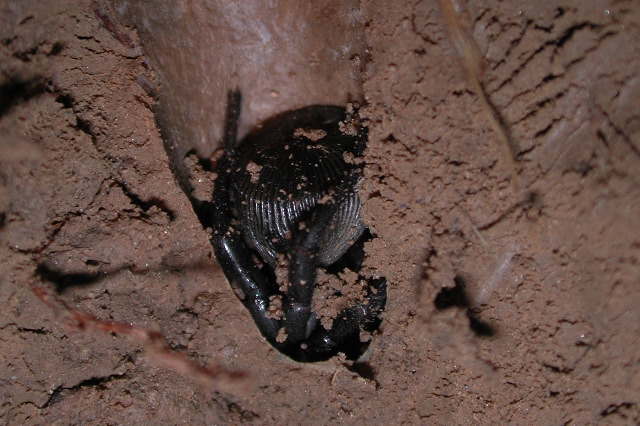
I have heard spider genus Cyclocosmia given the common names of trapdoor spider or coin spider. Both of these common names are problematic as they are also used for unrelated spiders. They use their abdomen to plug their hole when they are threatened. 

 This strategy has been recorded to have been successful in the repulsion of attacks from most spider's worst nightmare, pompilid wasps. As you can see, the posterior of the abdomen in Cyclocosmia is suddenly truncated giving it that unusual shape. It is also hardened and reinforced with ridges giving the appearance of some sort of ancient inscribed artifact.


Cyclocosmia are very long lived for a spider and have been known to survive up to 12 years in captivity. They are not very good disperses and are often found in close proximity to other members of the same species. By all accounts they seem to be fairly rare.

Distribution:
There are Cyclcosomia species  in east and south east Asia and in north and central America.

Classification:
Most members of the family Ctenizidia are referred to as trapdoor spiders as they have a similar lifestyle, however the word gets used for other taxa as well.
Kingdom: Animalia
Phylum: Arthropoda
Class: Arachnida
Order: Araneae
Family: Ctenizidia
Genus: Cyclocosmia

Image Links: