Showing posts with label Agaricales. Show all posts

Wednesday, 26 August 2015

Creature 330: Nidulariaceae


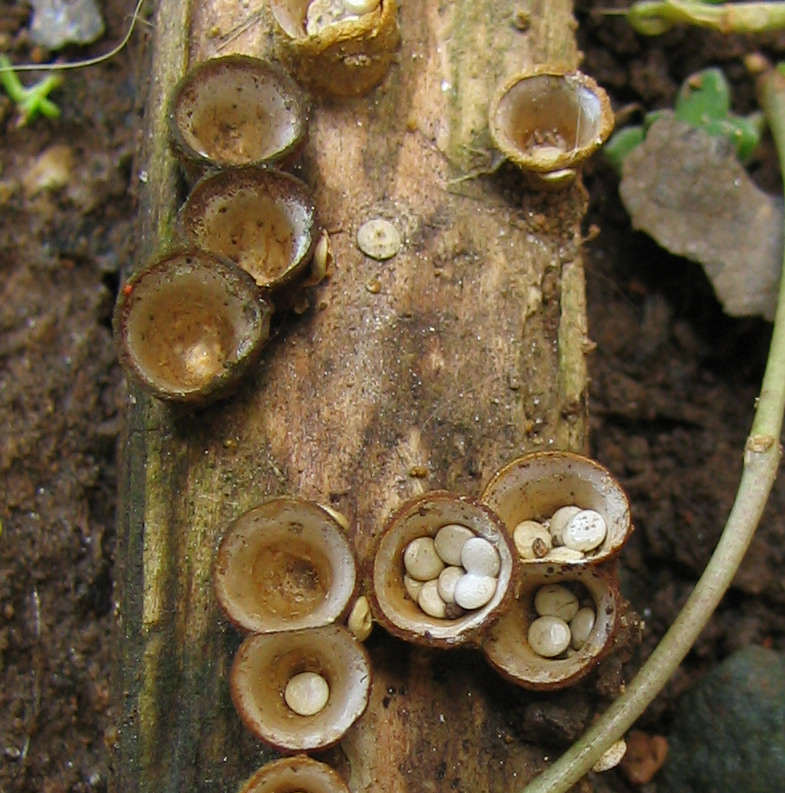
Bird's nest fungus

Nidulariaceae is called the bird's nest fungus, because it sort of looks like a birds nest with eggs in it.

The little 'eggs' contain spores which are supposed to be eaten by animals and spread over large 
distances. They get a but of a helping hand when it rains as the cup has a special shape which projects
 the spore packets up to 1 meter away when a raindrop falls in and splashes. Sometimes tiny sticky
 threads will be attached to the spores and will wrap around bits of vegetation which it comes in contact 
with.
Bird's nest fungi - context.jpg

Distribution:
The family is cosmopolitan.

Classification:
Kingdom: Fungi
Phylum: Basidiomycota
Class: Agaricomycetes
Order: Agaricales
Family: Nidulariaceae

Image Links:

Tuesday, 21 April 2015

Creature 203: Omphalotus olearius

It must taste really good
Description
Omphalotus olearius is a fungus which is sometimes known as the Jack O'Lantern mushroom.

It is often mistaken for members of the genus Cantharellus. Unlike Cantharellus the Jack O'Lantern mushroom is toxic to humans. While it will not kill you it will make you vomit and give you diarrhea and severe stomach cramps. If you turn the light off and look at them, you might think twice about eating them.

That's right, they glow in the dark. When things glow in dark and are poisonous that's usually enough to discourage me from eating them. However these mushrooms apparently smell and taste so good that even people who have been poisoned by them in the past find them appealing.

Distribution:
Omphalotus olearius is endemic to Europe.

Classification:
Kingdom: Fungi
Phylum: Basidiomycota
Class: Agaricomycetes
Order: Agaricales
Family: Marasmiaceae
Genus:Omphalotus
Species: Omphalotus olearius

Image Links:

Tuesday, 31 March 2015

Creature 182: Armillaria solidipes

The biggest living thing

Description:
Armillaria solidipes has the title for the largest living thing on earth. If you haven't heard of it, you are probably thinking it must be some sort of whale of giant tree. If so you are wrong. It is a fungus.

Like many fungi Armillaria solidipes is mostly made up of an enormous underground network of joined filamentous hyphae. The mushrooms are reproductive bodies they produce when conditions are right for a new fungus to grow. The largest individual Armillaria solidipes alive is in Malheur National Forest in Oregon U.S.A. it is believed to cover an area of 880 hectares underground with an average depths of 1 m. In some areas the fungal hyphae may be very sparse, while in other they form a thick mat under the ground.

The fungus is essentially parasitic deriving nutrients from the roots of the trees growing in the area. They can infest and eventually kill tree stumps and remain viable in a dead stump for up to 50 years.  They are incredibly difficult to eradicate. Due to their ability to continue growing from even a small branch they can live a very long time. The largest individual is believed to be 2400 years old.

Distribution:
Armillaria solidipes is found in throughout the northern temperate region.

Classification:
Armillaria solidipes has also been known as Armillaria ostoyae.
Kingdom: Fungi
Phylum: Basidiomycota
Class: Agaricomycetes
Order: Agaricales
Family: Physalacriaceae
Genus: Armillaria
Species: Armillaria solidipes