Friday, 5 June 2015

Creature 248: Microraptor

The smallest dinosaur

When you think of dinosaurs, you think of enormous lumbering giants, but not all of them were like that.
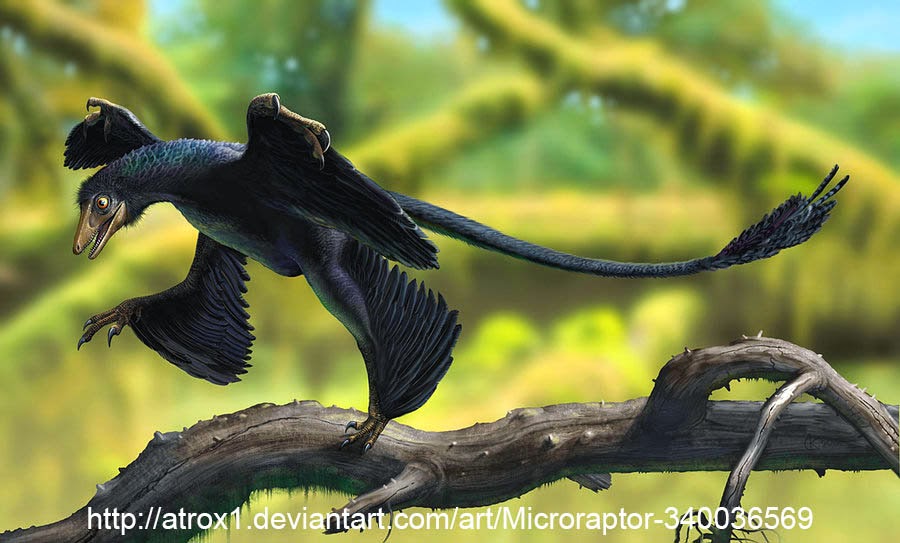


Microraptor is the smallest dinosaur we know (other than birds, which are a type of dinosaur). It was a true raptor related to velociraptor etc.... but it was less than a meter tall and probably only weighed about a kilogram. They probable fed mostly on fish.


Specimens of Microraptors posses some of the best preserved dinosaur feathers we have ever found, and have been studied in great detail. Our best guess based on the structure of the fossilized pigments is that their feathers were a shiny black color. Their feathers have a similar structure to birds feathers and may have been used for powered flight. Microraptor  had four wings, one on each limb. Opinion on their capability for powered flight is divided with some paleontologists asserting that they were probably only useful for gliding. If they were capable of powered flight they would have evolved this ability separate to the bird lineage.


Distribution:
Mutiple specimens of Microraptor  have been found from Liaoning, China and are 120 to 125 million years old.

Classification:
Kingdom: Animalia
Phylum: Chordata
Class: Sauropsida
Order: Saurischia
Family: Dromaeosauridae
Genus: Microraptor

Image Links:

Thursday, 4 June 2015

Creature 247: Unidentified fungus

One of my favorite and one of the most popular blog posts is the Ophiocordyceps post, the fungus which zombifies ants in order to spread.


What I didn't know when I wrote that post was that the story doesn't end there. According to a 2012 article Ophiocordyceps is not only a specialized parasite but also the host to another specialized fungal parasite. Once it reaches the stage when it starts producing a stalk to spread its spores another fungus grows over the top of it and sterilizes the Ophiocordyceps. It then begins to produce its own spores. This mysterious hyperparasite is yet to be identified and there is probably more than one.


Distribution:
They probably exist wherever you find Ophiocordyceps,  but it is all highly speculative at the moment.

Classification:
Kingdom: Fungi
Unidentified

Image Links:

Wednesday, 3 June 2015

Creature 246: Helicoprion

And you thought modern sharks were scary

Helicoprion is an extinct shark which does not have a common name that I know.


Most sharks have scary teeth, but the lower jaw on this one has a freaky looking spiral like projection covered in teeth. This bizarre structure probably formed gradually as the sharked aged growing outward as it gets older.

You are probably wondering what those thing is used for. Well your guess is as good as mine. It is very hard to tell with such a unique structure on an animal that went extinct so long ago. They could grow to about 4 meters in length making them a large shark, but they are not breaking any records.

Distribution:
Helicoprion  fossils are 310 to 250 million years old which means they predate the dinosaur era and went extinct in the Early Jurassic.

Classification:
The Helicoprion genus has been placed in an order named Eugeneodontida, whichnis completely extinct.
Kingdom: Animalia
Phylum: Chordata
Class: Chondrichthyes
Order: Eugeneodontida
Family: Agassizodontidae
Genus: Helicoprion

Tuesday, 2 June 2015

Creature 245: Poltys illepidus

Lurking on the trees

Poltys illepidus is a spider with a pretty cool camouflage.


Commonly known as the tree stump Orb-weaver due to its uncanny ability to blend in while hiding on a tree stump. If you don't look closely it looks like a lump on the tree. It remains perfectly motionless during the day and comes out to spin its web at night. It is quite a common species but is very good at hiding and most of the time you won't know it is there. The good news is they are not aggressive and their venom is harmless to humans.


Distribution:
This species has been recorded from North Queensland, Australia to continental South East Asia.

Classification:
Kingdom: Animalia
Phylum: Arthropoda
Class: Arachnida
Order: Araneae
Family: Araneidae
Genus: Poltys
Species: Poltys illepidus

Monday, 1 June 2015

Creature 244: Ricinus communis

The most deadly plant in the world?

Ricinus communis is commonly known as the Castor oil plant.

It is a widely cultivated garden plant and is kept for it beauty despite the fact that it is very deadly. According to the Guinness book of records it is the most deadly plant in the world,  however this is debatable.

The beans of the plant carry a toxin called ricin, the same one made famous in Breaking Bad. Eight beans are said to be enough to kill most people. The toxin ricin interferes with protein synthesis. Basically it stops almost every metabolic process in your body and you slowly die. The poison normally  kills within a week. Ricin is not undetectable and it is not untreatable.  If treatment is available the patient will usually survive. The symptoms vary from case to case but they can be a lot more severe than they seem to be in breaking bad. It is fairly hard to detect if you don't know what to look for.


Distribution:
The Castor oil plant is native to North East Africa and India but grows wild throughout the tropics and is widely cultivated.

Classification:
Kingdom: Plantae
Phylum: Angiosperms
Class: Dicotyledon
Order: Malpighiales
Family: Euphorbiaceae
Genus: Ricinus
Species: Ricinus communis

Image Links:

Sunday, 31 May 2015

Creature 243: Liphistiidae

Description:
Liphistiidae are a family of spiders which don't have a common name.

These spiders are remarkable because they remain morphologically very similar to 290 million year old fossils from the same suborder. This means they have a very highly conservative body plan. Their venom glands are tiny and for a while biologists believed they didn't have them. They lack parts of the respiratory system which are present in all other spiders. They live in tiny tube-like borrows and make use of trapdoors like many other spiders. 

Over the last 300 million years they have really got the whole trapdoor technique down packed.

Distribution:
Liphistiid spiders are found in East and South East Asia.

Classification:
Liphistiidae have been placed in a spider suborder called Mesothelae and are the only living spiders in this group. There are 3 extinct members of this group, all of which have a fairly highly conserved morphology. This suborder is the most basal group of spiders (i.e. it is the most distant relative of all other species of spiders). There are 8 genera in the family.
Kingdom: Animalia
Phylum: Arthropoda
Class: Arachnida
Order: Araneae

Image Links:
http://en.wikipedia.org/wiki/Liphistiidae
http://www.qldaf.com/forums/spiders-insects-invertebrates-photo-video-lounge-95/liphistius-most-primitive-spiders-alive-76343/

Video Links:
https://www.youtube.com/watch?v=e3sDJnqj7hY

Saturday, 30 May 2015

Creature 242: Mellisuga helenae

Insect sized bird
Description:
Mellisuga helenae is a hummingbird commonly called the bee hummingbird, because if you don't look carefully you might confuse it for a large bee.

They only grow to up to 6 cm long and son't weigh more than 2 grams. This makes it the smallest bird in the world. Like other hummingbirds they beat their wing in a figure 8 formation and do it so fast that they appear as a blur. They can complete 200 strokes per minute. They can fly at speeds of nearly 50 km per hour. Their tiny heart can beat up to 1200 times per minute. They are important pollinators of several flowers and are also highly dependent on them for energy. They will also opportunistically eat arthropods.


Distribution:
The bee hummingbird is endemic to the Caribbean, particularly Cuba.

Classification:
Kingdom: Animalia
Phylum: Chordata
Class: Sauropsida
Order: Trochiliformes
Family: Trochilidae
Genus: Mellisuga 
Species: Mellisuga helenae 

Image Links:
http://www.factzoo.com/birds/bee-hummingbird-smallest-bird-in-the-world.html

Video Links:
https://www.youtube.com/watch?v=lqDEcSZxEGQ