Tuesday, 7 July 2015

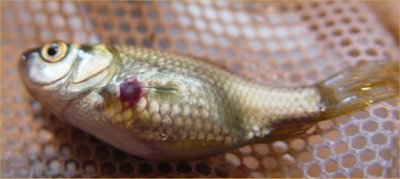
Creature 280: Lernaea

Parasitic crustacean

Lernaea is a genius of maxillopod crustacean which are usually called Anchor worms.

They have nine juvenile phases in which they are free living plankton of various forms. Once they are sexually mature they breed. At this point the males simply die off but the females go and find themselves a fish and dig into its flesh. The females body is then modified into a grappling hook shape, or an anchor shape.

The body segmentation and most of the organs are lost. Most of the organism is reduced but a long thin segment can often be seen hanging out of the body of the fish. The female essentially becomes a factory for producing and pumping out fertilized eggs.

Anchor worms are a common pest in fish tanks and aquaria all over the world.

Distribution:
Larnaea can be found all over the world.

Classification:
Kingdom: Animalia
Phylum: Arthropoda
Class: Maxillopoda
Order: Cyclopoida
Family: Lernaeidae
Genus: Lernaea

Image Links:

Monday, 6 July 2015

Creature 279: Bambusidae

More interesting than you think.

Bambuseae is the name of a grass tribe which you would probably know as Bamboo. But before you say 'Oh... I waited a whole day for Bamboo! I'm checking XKCD' please give this fascinating plant a chance.

Bamboo are not only the largest grass strongest and woodiest members of the grass family, but they are the fastest growing.  In fact they are the fastest growing organisms in the world.  Some species have been known to grow 91 cm in one day under ideal conditions. At that rate could get to most people's height in 2 days. Some bamboo have been known to grow up to 40 meters tall. Not bad for grass.

Not impressed yet? Well you would think that something which is thrown together that quickly would not be made very well but bamboo is so tough people can and do build houses out of it. It has a higher compressive strength than concrete and its tensile strength is in the same ball park as steel.


Distribution:
Bamboo can be found in all the world's topical regions and well into the temperate regions of East Asia, North and South America.

Classification:
Bamboo are a tribal level taxon in the grass family (Poaceae). There are thousands of species of Bamboo worldwide
Kingdom: Plantae
Phylum: Angiosperms
Class: Monocotyledon
Order: Poales
Family: Poaceae
Image Links:

Sunday, 5 July 2015

Creature 278: Hemicentetes semispinosus

Cool hair

Hemicentetes semispinosus is known as the lowland streaked tenerec.


Apart from their bizarre black and yellow hairy appearance these guys have found ways to us their hair that most mammals would never think of. Their quills are essentially big thick hairs and are very useful in self defense. When this little tenerec gets scared its quills become erect and point forward. At this point the tenerec uses them as a weapon and drives them into whatever it finds threatening. Some quills are armed with little barbs to make the whole experience a little less enjoyable for whatever is hunting the tenerec. Other quills have been specially modified to make noises as they are rubbed together. These noises are used as a means of rudimentary communication, especially for instances such as a mother and child trying to find each other.


Distribution:
Hemicentetes semispinosus can only be found in Eastern Madagascar.

Classification:
Kingdom: Animalia
Phylum: Chordata
Class: Mammalia
Order: Afrosoricida
Family: Tenrecidae
Genus: Hemicentetes
Species: Hemicentetes semispinosus

Image Links:

Saturday, 4 July 2015

Creature 277: Creobroter gemmatus

Cool looking flower mantis
Creobroter gemmatus is a mantis which uses flowers to camouflage and catch insects which are wandering around looking for nectar. Some of my regular readers will remember the devil's flower mantis which exhibits similar behavior.

This one is called the Jeweled flower mantis due to the weird jewel like marking on its wing. I think the marking is cool so it gets a post as a bizarre creature. There is not much else interesting about it.


Distribution:
Kingdom: Animalia
Phylum: Arthropoda
Class: Insecta
Order: Dichtyoptera
Family: Mantidae
Genus: Creobroter
Species: Creobroter gemmatus

Classification:
The jeweled flower mantis can be found throughout South and South East Asia.

Friday, 3 July 2015

Creature 276: Titanoboa

Big snake...

Titanoboa is such a good name for this snake that it is pretty much the same as the common name, the Titan boa.

As its name suggests,  the Titan boa was a big snake, in fact it is the biggest snake of all time. It could reach nearly 13 meters long and weighed over a ton.


Distribution:
The Titan boa lived in the 10 million years after the K-Pg extinction which wiped out most of the dinosaurs (or K-T if you prefer). Specimens come from Columbia.

Classification:
There is only one known species in the genus Titanoboa. It has been placed in the Family Boidae subfamily Boinae and so is a close relative of true Boas (genus Boa).

Kingdom: Animalia
Phylum: Chordata
Class: Sauropsida
Order: Squamata
Family: Boidae
Genus: Titanoboa

Image Links:

Thursday, 2 July 2015

Creature 275: Cyphoma gibbosum

Colorful snail with a boring shell

Cyphoma gibbosum is a brightly colored sea snail.

It has been given the common name flamingo tongue snail, although I can't imagine why. I don't think it looks anything like a flamingo's tongue.The interesting thing about this snail is that while it may look like it has a pretty shell, it actually has quite a boring plain white shell. The patterns are actually the color of the snails mantle which has grown over the shell. Its purpose is to provide a large surface area for the snail to absorb Oxygen from the water.


Distribution:
The flamingo tongue snail is known from the Caribbean sea and some coastal areas of Eastern South America.

Classification:
Kingdom: Animalia
Phylum: Mollusca
Class: Gastropoda
Order: Caenogastropoda
Family: Ovulidae
Genus: Cyphoma
Species: Cyphoma  gibbosum

Image Links:

Wednesday, 1 July 2015

Creature 274: Acherontia

Acherontia is a genus of moths which are commonly known as the Death's-head Hawkmoth.


The common name has something to do with the skull like marking on the pronotum. This marking varies between species and is more convincing in some species over others. The species Acherontia atropos is the fastest moth in the world, reaching speeds of nearly 50 kilometers per hour. Death's-Head Hawkmoths have an unusual habit of lodging themselves in bee hives and gorging themselves on honey. They achieve this by mimicking worker bee pheromones. The markings on their back are also suspected to be mimicking a bee's face. They also make a squeaking noise which is believed to mimic the noise worker bees make:


The caterpillar also looks pretty cool:


Distribution:
The genus is found across Europe and Asia.

Classification:
There are three species in the genus.
Kingdom: Animalia
Phylum: Arthropoda
Class: Insecta
Order: Lepidoptera
Family: Sphingidae
Genus: Acherontia

Image Links:
http://commons.wikimedia.org/wiki/File:Acherontia_lachesis_f.jpg
http://en.wikipedia.org/wiki/Death%27s-head_Hawkmoth

Video Links:
https://youtu.be/ITh0TgJ8a6Y