Sunday, 6 September 2015

Creature 341: Carcharias taurus


How to get ahead in life

Carcharias taurus is commonly known as the sand tiger shark or the grey nurse shark.

UShaka Sea World 1079-a.jpg

These large sharks can reach up to 3.2 meters long and usually live in large colonies. A feeding frenzy of these sharks can make for a difficult environment for smaller sharks which may struggle to get a fair share of the food. This had led to a fairly common condition in sharks which is called oviviviparity. They develop inside eggs, which are not laid by sit inside a pouch inside the shark. The egg hatches while still inside the pouch. In grey nurse sharks the young hatchlings don't leave immediately as it is useful to them to grow as large as possible before they are required to fend for themselves. After they hatch they consume the other hatchlings inside their mother's pouch. In every brood only one shark will survive after consuming all its siblings.

A sand tiger shark hatchling next to an embryo (the smaller one on the top left). Credit: D.ABERCROMBIE.

Distribution:
Sand tiger sharks can be found in temperate coastal regions all over the world.

Classification:
Kingdom: Animalia
Phylum: Chordata
Class: Chondrichthyes
Order: Lamniformes
Family: Odontaspididae
Genus: Carcharias 
Species: Carcharias taurus

Image Links:
https://en.wikipedia.org/wiki/Sand_tiger_shark
http://phenomena.nationalgeographic.com/2013/04/30/shark-dads-lose-babies-to-unborn-cannibal-siblings/


Saturday, 5 September 2015

Creature 340: Sula


Sula is a genus of six species of birds.


The cammon name for these bizarre looking bird is booby. Boobys look like they should be in a comedy with their awkward appearance and their feet which dramatically contrast in color. They are large birds with some species nearly reaching 1 meter tall. on some islands like the galapogas boobies don't display much fear and like the dodo were used by sailors as easy meals.
<p>Photo: A red-footed booby on a tree branch</p>


Distribution:
Various species of boobies can be found throughout the world's tropical coastal areas, but they are most diverse in the East Pacific.

Classification:
Kingdom: Animalia
Phylum: Chordata
Class: Sauropsida
Order: Suliformes
Family: Sulidae
Genus: Sula

Image Links:

Friday, 4 September 2015

Creature 339: Phymatinae


Surprise!

It's about time we had another assassin bug, considering it has been a while since the last and after all an assassin bug is the most viewed post on my blog.

Ambush Bugs (Phymatinae)

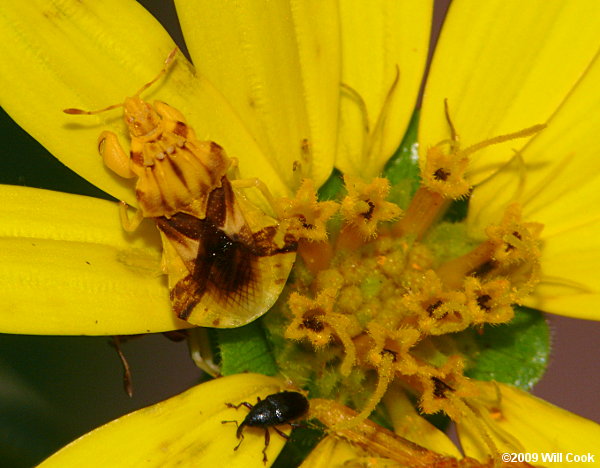
Phymatinae are a subfamily of assassin bugs commonly known as ambush bugs. Their speciality is camouflage and surprise attack on their prey. Their heavily armed raptorial forelegs and curved piercing rostrum enable them to take down prey which can get up to ten times larger than them.

Female Ambush Bug feeding on a Bumble Bee

Distribution:
Ambush bugs can be found anywhere,  but are most common bin tropical regions of Asia and the Americas.

Classification:
Kingdom:Animalia
Phylum:Arthropoda
Class: Insecta
Order: Hemiptera
Family: Reduviidae

Image Links:

Thursday, 3 September 2015

Creature 338: Dracorex hogwartsia


The dragon king of hogwarts
Dracorex hogwartsia is a recognised dinosaur species which has been recently (2006) described.
The Childrens Museum of Indianapolis - Dracorex skeletal reconstruction.jpg

It is the only species in the genus Dracorex, meaning dragon king. The specific epithet hogwartsia is a tribute to the Harry Potter series. Its spiky head and long muzzle probably gave it a dragon-like appearance.

DracorexHogwartsia02
The name might be pretty cool, but it may not exist forever.  Some scientists believe they it is not a separate genus or species but that it is the juvenile form of a species of Pachycephalosaurus. Apparently the bizarre horns and bumps on the head changed quite dramatically as the dinosaur matured. I have no idea which hypothesis is correct.

Distribution:
The only fossil which has ever been uncovered was found in South Dakota and is from the late Cretaceous.

Classification:
Kingdom:Animalia
Phylum:Chordata
Class: Sauropsida
Order: Ornithischia
Family:Pachycephalosauridae
Genus:Dracorex
Species: Dracorex hogwartsia

Image Links:

Wednesday, 2 September 2015

Creature 337: Trychopeplus laciniatus


Impressive camouflage

Trychopeplus laciniatus is a stick insect commonly known as the moss mimic walking stick.

This species blends in to the moss that grows on trees in the dense rainforest that they live in. I think it is a pretty impressive camouflage. The intricate structures on the outside are just part of the insects exoskeleton which has grown into all kinds of weird and wonderful shapes.

Trychopeplus laciniatus L2.2

Distribution:
Moss mimic walking sticks are found in Costa Rica.

Classification:
Kingdom: Animalia
Phylum: Arthropoda
Class: Insecta
Order: Phasmatoidea
Family: Diapheromeridae
Genus: Trychopeplus 
Species: Trychopeplus laciniatus

Image Links:
http://entomologydiary.typepad.com/home/trychopeplus-laciniatus-phasmatodea-diapheromeridae.html
http://gallery.kunzweb.net/main.php?g2_itemId=20267

Tuesday, 1 September 2015

Creature 336: Dicyemida


Not everyone's unique

Dicyemida is a strange phylum of small parasitic animals that specialise on cephalopods. 

An adult dicyemid. These extremely simple animals live inside the kidneys of cephalopods, typically octopuses and cuttlefish. It seems as though their relationship with the host may have extended beyond parasitism to become a mutualism. Photo: © Hidetaka Furuya.

Their bodies are not very complicated, lacking most basic organ systems common in the rest of the bilateria such as a digestive or excretory system or even a brain. Individuals of the same species have exactly the same number of cells when they are adults. The larger species can grow up to 7mm long.

Distribution:
Juvenile Dicyemida are found on the ocean floor in temperate oceans. Adults are found inside cephalopods and are usually temperate but can sometimes be found outside temperate regions.

Classification:
Kingdom: Aminalia
Phylum: Dicyemida

Image Links:

Monday, 31 August 2015

Creature 335: Myzopoda


Myzopoda are a genus of bats commonly known as old-world sucker foot bats.

Sucker-Footed Bat

Like the South American sucker foot bats they have tiny suction pads on their wrists and ankles which enables them to latch onto objects, even smooth surfaces. However they are so distantly related from any other bats in that they have been given their own family. They are the most basal genus in their subfamily Noctilionoidea.


Distribution:
The genus only exists in Madagascar, but fossil evidence indicates they once existed in Africa.

Classification:
Kingdom: Animalia
Phylum: Chordata
Class: Mammalia
Order: Chiroptera
Family: Myzopodidae
Genus: Myzopoda

Image Links:
http://www.supremelists.com/top-10-weird-looking-creatures
http://bats.mampam.com/madagascar/images/myzopoda/pages/36_jpg.htm