Sunday, 7 December 2014

Creature 68: Cirripedia

The horrifying truth behind barnacles

Have you ever  been watching a nautically themed movie and wondered exactly what a barnacle was and how they always seem to accumulate on the bottom of ship? Barnacles are the common name foe the Infraclass Cirripedia (Class Maxillopoda: Subphylum Crustecea). That's right they are a type of crustacean and despite apperarences are not related to mollusks.

Description:
Barnacles, like most crustaceans, have separate juvenile and adult phases. Their life cycle can be divided into three phases, the Naupilus phase, a free living plankton phase which most crustaceans including crabs and lobsters go through; A cypris phase, a free living stage unique to barnacles in which the barnacle seeks a a suitable substrate to attach itself to; and an adult phase in which the barnacle becomes sessile, cements itself to the substrate and encases itself in a hard shell.

Barnacle Naupilus


The cypris will glue itself to a suitable substrate with various proteins it excretes out of its cement glands. If you have ever tried to move a barnacle you would know that these proteins are a fairly effect cement.

Barnacle Cypris

Their shell is normally constructed of six plates and is made of a chitinous interior with a calcium carbonate exterior. Barnacles filter feed on passing plankton. They legs have been modified into long feather like structures called cirri which they can extend outside of their shell in order to trap food and bring it back inside the shell.

Adult goose Barnacles


Barnacles are mostly fairly boring unless you are into that sort of thing. There is one really cool genus that I know of.There is a genus of barnacle which does not form a shell like covering as all other barnacles do. Genus Sacculina  is a parasite which infects crabs. When a crab is infected with Sacculina it loses its ability to molt, regrow limbs and reproduce weather it is male or female. The Sacculina parasite then deposits eggs where the female crabs would normally carry her own egg (Sacculina also does this to male crabs it has castrated) and the crab will look after the eggs as if they were their own offspring.

Distribution:
Barnacles are found in all the worlds seas and oceans.

Classification:
While Cirripedia are in the Crustecean subphylum they are not in the Class Malacostraca, in which you will find most of your 'typical' crustaceans such as crabs and lobsters. Their class, Maxillopoda contains mostly planktonic crusteceans, including copepods which make up a very large part of the oceans plankton. (I'm pretty sure Plankton from Spongebob Squarepants is a Calanoid Copepod). Their subclass Thecostraca contain 3 infraclasse: The barnacles as discussed above. Facetotecta, a planctonic juvenile but we don't know the adults. This will be included in another blog entry. The third is a group called Ascothoracida which are free living plankton as juveniles but parasites as adults.

Kingdom: Animalia
Phylum: Arthropoda
Class: Maxillopoda

Image Links:
http://invert-embryo.blogspot.com.au/2011/05/molt-of-larval-barnacle.html
http://www.microscopy-uk.org.uk/mag/indexmag.html?http://www.microscopy-uk.org.uk/mag/artjan99/barnac.html
http://en.wikipedia.org/wiki/Barnacle#mediaviewer/File:Entenmuscheln.jpg

Three types of animals.

There is a new page on the side basically discussing why you should never watch an alien movie with me.

Saturday, 6 December 2014

Creature 67: Gasteracantha

This will change your opinion on spiders
Description: 
I don't know why spiders have such a reputation for being creepy when there are so many spiders like the genus Gastrocantha. Their common name is the spiny orb weavers and if you don't like the way they look you are dead to me.

Gasteracantha westringi

Unlike most spiders it is fairly easy to differentiate the species within the genus due to their large spines and spectacular coloration which varies significantly between species, although sometimes the color varies significantly within a species as well

Gasteracantha cancriformis


They have 3 pairs of spines or dramatically varies size and shape on their abdomen, which probably serve an anti-predatory function. There are dozens of species in the genus and as you can imagine there are many more color morphs to marvel at, but I'll leave that to you and Google.

Distribution:
This genus is found on every fragment of the former super continent Gondwanaland distribution with members from India, Australia, The South East Asian Islands, South and Central America, Indian ocean Islands, Madagascar, Pacific Islands and Africa. There are species with a Central and North American range which are particularly common in Florida.

Classification:
Kingdom: Animalia
Phylum: Arthropoda
Class: Arachnida
Order: Araneae
Family: Araneida
Genus: Gastrocantha

Image Links:
http://ednieuw.home.xs4all.nl/australian/araneidae/araneidae.html
http://en.wikipedia.org/wiki/Gasteracantha_cancriformis#mediaviewer/File:Crablike_Spiny_Orb_Weaver.jpg
https://skeptoid.com/blog/2013/03/29/my-fascinating-backyard-spiny-backed-orb-weaver-spider-spider-myths/

Friday, 5 December 2014

Creature 66: Hypnos monopterygius

This will shock you.
Description:
Hypnos monopterygius is a species of electric ray commonly known as a coffin ray. Now if you're used to pictures of large manta rays you might think that this guy is a bit of a wimp due to its tiny rounded tail. 

When fully grown they normally reach a size of around 40 cm, which is no manta ray but is fairly large. They are voracious predators and great at defending themselves due to their ability to deliver powerful electric shock. This nocturnal species lives on the ocean floor and hunts mostly benthic fish but has been known to attack small birds or mammals which wonder into the intertidal zone. They deliver shocks of up to 30 amperes and 200 vaults and can recharge quickly enough to deliver shocks 50 times in 10 minutes. Despite their name and power of this shock there are no recorded deaths by coffin rays, but I still don't recommend trying this:

This photo is my own work, you can use it in whatever way you want foe whatever purpose you want, without conditions. If you so use them, I consider it good manners to include a link to this site.

This ray can distend is jaw to swallow large troublesome prey. These jaws contain over 60 rows of teeth on each jaw. They don't lay eggs but give birth to free living young.

Distribution:
Coffin rays are found along the coast of Australia in temperate regions in depths of up to 80 m.

Classification:
Kingdom: Animalia
Phylum: Chordata
Class: Chondrichthyes
Order: Torpediniformes
Family: Torpedinidae
Genus: Hypnos
Species: Hypnos monopterygius

Thursday, 4 December 2014

Creature 65: Dromornithidae

Mega-ultra chicken?  No, shhhh he is legend.
Description:
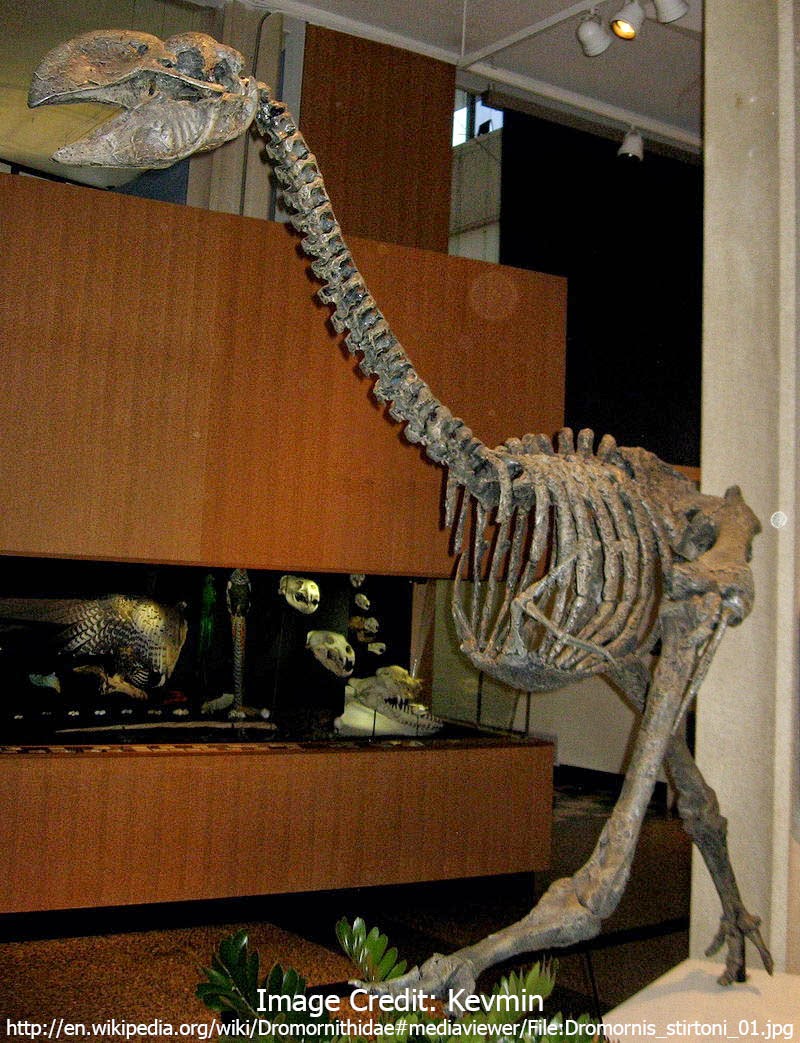
Dromornithidae is an extinct family of Australian flightless birds sometimes given the cool nickname Thunderbirds. They were large, probably carnivorous and savage looking earning some species some quite dramatic nicknames such as the demon duck of doom

The largest of these, Dromornis stirtoni grew up to 3m tall (ca 10 ft) and weighed up to 500kg and is possibly the largest bird to have ever existed. 

Their legs are well adapted to running fast and their  beaks are large, thick and heavy. They had a wide field of vision with a blind spot of about 40 degrees.
The group only went extinct fairly recently, somewhere between 50, 000 and 20, 000 years ago and so they most likely encountered humans at some point. Leaving aside any debates as to weather humans had something to do with their extinction,  just imagine coming across one of these monsters armed with nothing more than a fancy stick and some sharpened stones. In some Aboriginal legends giant emu like birds existed, however considering that their mythology is full of giant creatures I would not take this as evidence that they came in contact with these monsters.

Distribution:
Fossils of this Family start appearing in Australia in the Oligocene. They are most common in the east and the north.  there are no confirmed finds anywhere else but a possible fragment has been found in Antarctica. Given their abundance in the North and the on and off land bridge across the torres strait it is fairly likely that they existed in New Guinea at some point.

Classification:
Despite what you might assume from their size and location Dromornithidae are unrelated to the modern large flightless birds the ratites. They are related to modern day water fowls in the family Anseriformes and despite the headline of this entry they are not actually close to chickens.
Kingdom: Animalia
Phylum: Chordata
Class: Sauropsida
Order: Anseriformes
Family: Dromornithidae

Image Links:

Wednesday, 3 December 2014

Labels

I've added a new category of labels so you can look for particular themes. The taxonomic labels are a bit long and notbuser friendly so I think I will seperate them into the four categories Kingdom, Phylum, Class, Order.

Creature 53: Deinacrida heteracantha

The biggest insect in the world*

I'm getting a growing number of hits from New Zealand, and given the variety of weird taxa from their insane archipelago I realize that I may be amiss to have not included any of them yet, so for all you kiwis out there. (I'm not talking about the bird or the fruit) today's creature is Deinacrida heteracantha, commonly known as the Little Barrier Island giant weta.

Description:
There are several species which are called weta in New Zealand which do not form a natural group, see the classification section for detail. In any case New Zealand certainly has the largest members of the group. This particularly species was chosen as it is the largest species and indeed is the largest insect in the world by weight (not by length). There are some claims that certain goliath beetles can weigh more, but as far as I can tell these have not been substantiated. So congratulations guys, you win this one, but Vegemite is still Australian.

New Zealanders tell me that some species of weta have a habit of giving people a shock by hiding in the toilets. They also reportedly have a nasty bite. I can imagine those two facts together conspiring into something rather unpleasant.

Video Disclaimer: This is not the endangered Little Barrier Island giant weta, but a different species I can't tell which but presumably it is a plentiful species and not and endangered one. These giants of the insect world are fairly omnivorous and will eat fruit, roots, vegetation or other insects.

Distribution:
Despite its name the Little Barrier Island giant weta is not restricted to Little Barrier Island but is found on a few islands in the north of New Zealand, although some of these are reintoductions. The species did once have a much larger range which at least included the North Island of New Zealand but its range and numbers have been diminished since the introduction of several pest species into New Zealand.

Classification:
The name weta can be confusing because it often referred to members of either the family Anostostomatidae or Raphidophoridae. To say that wetas only exist in New Zealand is a tautology because the term is a Maori name for several species which do not form a monophyletic group. There are members of the family Anostostomatidae in Australia and South Africa, which are not called wetas because they have not been named such by the Maori. The group diverged from its closest relatives a very long time and are an example of a relict gondwanan taxon. Deinacrida is the only member of its genus.

Kingdom: Animalia
Phylum: Arthropoda
Class: Insecta
Order: Orthoptera
Family: Anostostomatidae
Genus: Deinacrida
Species: Deinacrida heteracantha

Image Links:
http://en.wikipedia.org/wiki/Deinacrida_heteracantha#mediaviewer/File:Little_Barrier_Island_giant_weta-little_barrier_2011-2.jpg


Video Links:
https://www.youtube.com/watch?v=hBnssLXZEwI