Showing posts with label Acinopterygii. Show all posts

Thursday, 27 August 2015

Creature 331: Opisthoproctidae


Fish with a transparent head

Opisthoproctidae are a weird family of fish commonly known as Barreleye fish or Spook fish.


This is probably due to the bizarre adaptations to their eyes which they need for the dark areas on the depths of the ocean in which they live. They have enormous eyes with massive lenses which usually face upward but can be rotated to face forward if they want to change their field of view. Their dome shaped head is transparent in order to refract light into their massive eyes.

Distribution:
Opisthoproctidae can be found in all the world's oceans at depths of 400-2,500m

Classification:
Kingdom: Animalia
Phylum: Chordata
Class: Actinopterygii
Order: Argentiniformes
Family: Opisthoproctidae

Image Links:
http://pyramidbeach.com/2010/10/20/macropinna-microstoma/

Wednesday, 15 July 2015

Creature 288: Antennariidae

Yes, it is a fish

For some reason I don't understand this family of fish called Antennariidae is referred to in the common tongue as frog fish.

Frogfish are related to Melanocetidae, the finding nemo style angler fish. Frofish also have lures to catch their prey. Some frogfish can swallow prey twice their size. Their body is covered with weird bumps and spines and some species will grow plants or animals on their skin to camouflage. 
Many frog fish posses the ability to change their color or even their shape to aid in camouflage. They don't swim very much, which is weird considering they are fish. They prefer tho use their fins to walk along the ocean floor.

The next  image is my own, do what you want with it.


Distribution:
Frogfish live in tropical and subtropical water all over the world. Unlike many related families they are usually shallow water dwellers often living in reefs. There are a few deep sea species.

Classification:
Kingdom: Animalia
Phylum: Chordata
Class: Actinopterygii
Order: Lophiiformes
Family: Antennariidae

Image Links:

Sunday, 12 July 2015

Creature 285: Chaenocephalus aceratus

Bloodless fish
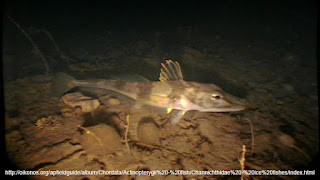
Chaenocephalus aceratus is a type of antarctic ice fish, a group that dominates the freezing waters off the coast of Antarctica.

All members of this group have to be fairly well adapted for the cold and you would think that they would have to be fairly warm blooded fish. Chaenocephalus aceratus is more of a no blooded fish. It is the only vertebrate to have lost its blood. It still has a sort of translucent liquid made of of plasma pumping through its veins, but it has no blood cells and not even haemoglobin is present. Haemoglobin is the molecule vertebrates use to carry Oxygen around the body. Plasma can carry a limited amount of Oxygen, but it is only 10% as efficient.  To make up for this Chaenocephalus aceratus has an enormous heart and a higher volume of blood. This raises the question as to why they would loose rid of their blood. It doesn't give them an advantage in surviving the cold. I can't really answer that convincingly.

Distribution:
Chaenocephalus aceratus is known from a southern ocean island called Bouvet Island and from the waters around the Antarctic peninsula.

Classifications
Chaenocephalus aceratus is the only member of its genus.
Kingdom:Animalia
Phylum:Chordata
Class:Actinopterygii
Order:Perciformes
Family:Channichthyidae
Genus:Chaenocephalus
Species:Chaenocephalus aceratus

Image Links:

Friday, 26 June 2015

Creature 269: Hoplostethus atlanticus

How old can a fish get?

Hoplostethus atlanticus is a deep sea fish which is commercially known as the orange roughly.

Apart from the fact that it just looks weird it is somewhat of an extremophile. They only live at cold temperatures between 3 and 9 degrees Celsius. They don't seem to mind though, as specimens of Orange roughy have been aged to a maximum of 149 years old. They are extremely slow growing organisms and can take 30 years to reach maturity. They

Distribution:
Orange roughy have been found in various disjunct locations across all oceans of the world at depths of between 180 and 1800 m.

Classification:
Kingdom: Animalia
Phylum: Chordata
Class: Actinopterygii
Order: Beryciformes
Family: Trachichthyidae
Genus: Hoplostethus
Species: Hoplostethus atlanticus

Image links:

Saturday, 13 June 2015

Creature 256: Sternoptychinae

These fish are like ghosts

Sternoptychinae are a subfamily of deep sea bony fish which are commonly called hatchetfish.
Their common name comes from the fact that their body is laterally flattened giving them the overall shape of a hatchet blade. I think it gives them a really spooky appearance.


If their appearance doesn't convince you they are like ghosts, you should consider the fact that they can turn invisible. When they are being attacked by a predator they give of faint lights from their skin. That far under the surface most animals can only really see the difference in light caused by the shadow cast by certain objects. When hatchetfish glow at the same intensity as the light around them so they effectively have no shadow. This renders them invisible to many of their predators.


Distribution:
Hatchetfish can be found across most of the worlds oceans at depths of 50 to 1500 meters.

Classification:
There are about 45 species in the subfamily. Their common name hatchetfish is also used for a completely different group of freshwater bony fish.
Kingdom: Animalia
Phylum: Chordata
Class: Actinopterygii
Order: Stomiiformes
Family: Sternoptychidae

Image Links:

Thursday, 14 May 2015

Creature 226: Myctophidae

Look at the pretty lights

Myctophidae are a family of deep sea fish known as lantern fish.

They are called lanternfish because of their tendency to light up like a lantern. As they live so far below the ocean surface that light cannot penetrate to their depth they need light patterns for sight to be useful in recognizing other members of the same species for mating. Some of these light patterns can be quite spectacular.

Lanternfish are actually quite common in the deep ocean and probably make up the majority of the fish species down there. They are known to follow a classic diel vertical migration pattern.


Distribution:
Lanternfish are found in all the world's oceans at depths of between 400 and 900 meters.

Classification:
Kingdom: Animalia
Phylum: Chordata
Class: Actinopterygii
Order: Myctophiformes
Family: Myctophidae

Image links:

Sunday, 3 May 2015

Creature 215: Phycodurus eques

There be dragons
Description:
Phycodurus eques is a fish which you might have heard of referred to as the leafy sea deagon.

The weird leafy lobes on their body are a form of camouflage giveing them the appearence of seaweed. They can even change color to match the seaweed and their movements mimic floating seaweed.

Distribution:
The leafy sea dragon is found on the southern coast of Australia.

Classification:
You are probably thinking it looks like a seahorse, well that's because the genus Phycodurus is in the same family as the sea horses. Phycodurus eques is the only member of this genus.
Kingdom: Animalia
Phylum: Chordata
Class: Actinopterygii
Order: Syngnathiformes
Family: Syngnathidae
Genus: Phycodurus
Species: Phycodurus eques

Image Links:

Sunday, 19 April 2015

Creature 201: Eurypegasus draconis

A fish that sheds its skin in one piece
Description:
Eurypegasus draconis is commonly known as the Dragon sea moth, the little dragonfish or the short dragonfish.

Dragon seamoths change the color of their skin to match their surroundings, which is not exactly a unique trick but is always pretty cool. You would think that this would mean that they invest a lot in their skin which makes it valuable to the. This is not the case. They shed their skin periodically and in one piece.

Distribution:
The dragon seamoth is found in tropical Indopacific waters.

Classification:
Sea moths are a small family of fishes similar to the dragon seamoth. They are in the same order as sea horses, as you might have guessed from the shape of their head.
Kingdom: Animalia
Phylum: Chordata
Class: Actinopterygii
Order: Gasterosteiformes
Family: Pegasidae
Genus: Eurypegasus
Species: Eurypegasus draconis

Image Links:

Thursday, 19 March 2015

Creature 170: Oxudercinae

Fish out of water
Description:
Oxudercinae are a subfamily of Ray finned fish which bear the common name mudskippers.


These little fish are capable of spending days at a time on moist land. Contrary to common belief, most fish can respire on land, they just can't do it very well. Often their gills will collapse without the support of the water making them less effective. Their gills also become less and less effective the drier they get. Mudskippers are no exception here, but in a similar way to amphibians they have developed a method for breathing through their skin, provided it remains moist. Unlike most fish they are adept at walking around on the land and can even jump up to 2 feet in the air. Like other true fish they are adept swimmers.


Mudskippers are very territorial and highly aggressive towards each other. But their fights don't look so intimidating:

O.K. so maybe those noises aren't real.

Distribution:
Mudskippers have an Indo-pacific distribution but are restricted to moist habitats.

Classification:
As mentioned above, mudskippers are ray finned fish, which means they are not closely related to the group of fish which eventually evolved into land animals. The amphibious lifestyle is convergent. They are in no way part of the amphibian group.

Kingdom: Animalia
Phylum: Chordata
Class: Actinopterygii
Order: Perciformes
Family: Gobiidae

Image Links:

Video Links:

Thursday, 29 January 2015

Creature 121: Echeneidae

A fish with a huge suction pad.

Description:
Echeneidae are a family of fish which are commonly referred to by the name remora. They are sometimes also called sucker fish for reasons which should become obvious.


In case you were wondering that large flattened ribbed structure is on the top of their head. They use it to create suction as they attach themselves to sharks or other large marine animals to hitch a ride. Most species have a particular type of animal on which they will preferentially attach themselves. There are some species which will even attach themselves to the inside of a sharks mouth and feed off the scraps. 


This may seem like parasitic behavior but in at least some cases the remoras will eat the parasites off the hosts as a food source which benefits both species. The remora will eat the parasites, scraps of food which the larger host drops and sometimes even the feces of their host. Many species have been known to swarm in large numbers around larger hosts.


Distribution:
Remoras are found in tropical open oceans but will sometimes hitch a ride outside of their comfort zone.

Classification:
The common name remora is also the scientific name of a genus within the family Echeneidae.
Kingdom: Animalia
Phylum: Chordata
Class: Actinopterygii
Order: Perciformes
Family: Echeneidae

Image Links:

Friday, 23 January 2015

Creature 115: Gnathonemus petersii

A very brainy fish
Description:
The colloquial name forGnathonemus petersii  is Peter's elephantnose fish. O.k. I admit it, this one is mostly here because I really like the name. Having said that it does have a pretty weird looking nose:

It also does have some pretty cool facts to go with it. Peter's elephantnose fish is covered in tiny little electrorecptors which have a sensory function. They are particularly dense on the long protrusion we would call a nose. They use these abilities to 'feel' their way around.They also give off a tiny electic current which they can use to identify other elephantnose fish when finding mates. As they usually live in muddy water with low visibility this - is quite a useful substitute for their sight, which is poor.

Peter's elephantnose fish also has a very big brain for it's size. In fact it has the largest brain to body weight ratio of any known vertebrate animal, yes that includes you. They are often raised as pets and in Aquaria all over the world.  Despite the fact that their preferred natural habitat is very muddy turbid water, they do not cope well with industrial pollutants and have been used as indicators of water quality.  They are nocturnal and rarely come out during the day. They prefer to hide among submerged branches and rocks during the day.


Distribution:
Peter's elephantnose fish is found in fresh water systems of West and Central Africa.
Classification:
Kingdom: Animalia
Phylum: Chordata
Class: Actinopterygii
Order: Osteoglossiformes
Family: Mormyridae
Genus: Gnathonemus
Species: Gnathonemus petersii

Image Links:

Saturday, 17 January 2015

Creature 109: Regalecus glesne

The original sea serpent

Description:
In an earlier post I discussed the real life sea monster, the colossal squid. Another common feature of maritime legends is the giant sea serpent. If there is a living creature which fits the description of a giant sea serpent it is Regalecus glesne, the giant oarfish sometimes called the king of Herrings.

The giant oarfish is a long eel-shaped fish (but it is not an eel!). Its dorsal fin ectends along the entire length of the body. So how long can it get? Records are not common but the longest on record that can be confirmed was 11m in length making it the longest bony fish in the world (bony fish includes fish with calcified bone, it does not include distant groups such as sharks and rays). Unconfirmed accounts claim that they can grow up to 17 m in length.

Giant oarfish lack scales and their skin is apparently quite fragile and easy to damage. They may look like an evil sea monster, but their diet consists almost enitrely of plankton and they are quite harmless. Large specimens of giant oarfish which was up on beaches still give people quite a fright to this day and inevitably cause local controversy. Appearance of the oarfish is associated with earthquakes in Japanese culture, however I am always very skeptical of these stories.

Distribution:
Giant oarfish can be found in all the world's oceans and are believed to be migratory.  It is possible that they have been the inspiration for stories about giant sea serpents all over the world.

Classification:
Kingdom:Animalia
Phylum:Chordata
Class: Actinopterygii
Order: Lampriformes
Family: Regalecidae
Genus: Regalecus
Species: Regalecus glesne

Image Links:

Sunday, 11 January 2015

Creature 103: Ogcocephalus darwini

A fish with makeup
Description:
Ogcocephalus darwini is known as the Red-Lipped Batfish because they are batfish and they have red lips. When I say red lips, I mean really red:

Despite being fish, they are actually not very good at swimming and rely mostly on crawling along the ocean floor on their bony jointed fins. That nose-like projection on the top of their head is actually a lure which is bio-luminescent. It attracts prey towards it in much the same way that the angler fish hunts. They live fairly close to the water's surface compared with other bio luminescent fish, which usually live in the aphotic zones of the ocean. Red-Lipped Batfish live at depths of 3 m or deeper.


Distribution:
Red-Lipped Batfish are found off the coast of the Galapagos Islands and the Cocos Islands (Costa Rican Cocos Islands, Not the Indian ocean Cocos Islands).

Classification:
Kingdom: Animalia
Phylum: Chordata
Class: Actinopterygii
Order: Lophiiformes
Family: Ogcocephalidae
Genus: Ogcocephalus
Species: Ogcocephalus darwini

Sunday, 28 December 2014

Creature 89: Dolichopteryx longipes

A fish with mirror eyes
Description:
Dolichopteryx longipes is commonly known as the brownsnout spookfish. That name alone is enough to call it bizarre, but take a look at its appearance:

Its skin is completely transparent and the rest of its body is sometimes quite translucent.
Instead of using lenses in their eyes to focus their vision on objects they use small mirrors located interior to their eyes. Apparently this is a superior method when you are trying to see the many bioluminescent organisms that live in the oceans abyss.

Despite the fact that the species was first described in 1888, it was not until 2009 that the scientific community saw its first living specimen of this bizarre creature.

Distribution:
The Brownsnout spookfish live at depths between 500 and 2500 m below the surface of the ocean. They have been found in the Pacific and Atlantic oceans.

Classification:

Kingdom: Animalia
Phylum: Chordata
Class: Acinopterygii
Order: Argentiniformes
Family: Opisthoproctidae
Genus: Dolichopteryx
Species: Dolichopteryx longipes

Image Links:
http://quantumbiologist.wordpress.com/2011/04/26/four-eyes/
http://old.richarddawkins.net/articles/3504-39-spookfish-39-has-mirrors-for-eyes

Tuesday, 28 October 2014

Creature 28: Psychrolutes marcidus

The ugliest animal in the world

Description: 
What is the ugliest animal in the world? There is some pretty tough competition out there but according to competition run by the ugly animal preservation society the reigning champion is Psychrolutes marcidus commonly known as the blobfish. The competition was aimed at drawing attention to some of the less charismatic animals.  I find as all the animals which did well were vertebrates anyway. Having said that, it is a very ugly fish.

The blobfish is a deep sea fish. It's body has a density just lower than that of the surrounding water allowing it to float almost effortlessly above the benthic floor. This low body density accounts for its shriveled appearance when it is taken out of the water as the air is not dense enough to support its body. In its natural state it probably looks something like this:


Of course this fact has caused some people to argue that the competition was not fair as the blobfish is not nearly so ugly in its natural state. I think these people are mostly New Zealanders who are disappointed that the kakapo did not win. Whenever an Australian win anything, even an ugly contest, the New Zealanders get jealous and either pretend that it is actually from New Zealand or that the Australians cheated.

Distribution:
The blobfish is found of the south and east coasts of Australia in the mesopelagic and bathypelagic zones. There are claims that some specimens have been found off New Zealand, but see discussion above for conspiracy theory.

Classification:
Kingdom: Animalia
Phylum: Chordata
Class: Actinopterygii
Order: Scorpaeniformes
Family: Psychrolutidae
Genus: Psychrolutes
Species: Psychrolutes marcidus

Image Links:

Friday, 10 October 2014

Creature 10: Melanocetidae

Just like finding nemo

Description: Today’s animal is the hideous looking deep sea fish Melanocetidae, commonly known as the clack sea devils, which are a type of deep sea angler fish. They are famous for its unusual strategy of luring in its prey with a small light producing structure attached to {an outgrowth of their spine}. The end of this structure contains bioluminescent bacteria, which produce the glow that entices their prey. The angler fish will lure them in and then, well with teeth like that you can imagine what will happen.


Most people have heard of the angler fish at least from finding nemo and have heard all that stuff about the bioluminescent bacteria, but what is less often mentioned is that this is only the female. Male angler fish are much smaller than the females, often 10 times smaller or more. They exhibit a rare life history strategy known as sexual parasitism. This is one of the most bizarre examples of parasitism in the animal kingdom. When they reach sexual maturity they latch on to a female and eventually burrow under her scales. They then parasitise the female for the rest of their life while fusing their circulatory systems together. Most of the body of the male fish is further reduced once it has becomes attached to a female, except the testicles which expand, providing the female with a means of fertilizing her eggs. In fact the male anglar fish Photocorynus spiniceps (Family Lynophrynidae) is said to be the smallest fish in the world. Some females can have up to 6 males living off them. I guess this behaviour is a product of the fact that members of the same species are hard to come by in the aphotic zones of the ocean, so when you find them, you latch on.
They can catch prey which is larger than themselves and stretch their body more than twice its original size to accommodate them, probably due to the scarcity of food in the aphotic zone.


Distribution:
Melanocetidae are found in all the world's oceans, but only in the mesopelagic, bathyalpelagic and higher up in the abyssalpelagic zones of the ocean.

Classification:
Actually the term angler fish can apply to any member of the Order Lophiiformes, and not all of them live in the deep ocean. I decided that the Melanocetidae had the meanest looking appearance out of the Anglerfish families. The family contains only a single known genus; Melanocetus.

Kingdom: Animalia
Phylum: Chordata
Class: Acinopterygii
Order: Lophiiformes
Family: Melanocetidae

Image links:
http://commons.wikimedia.org/wiki/File:Melanocetus_johnsonii.001_-_Natural_History_Museum_of_London.JPG?uselang=en-gb
http://mudfooted.com/deep-sea-anglerfish-bizarre-reproduction/
http://commons.wikimedia.org/wiki/File:Melanocetus_johnsonii.002_-_Natural_History_Museum_of_London.JPG?uselang=en-gb

Friday, 3 October 2014

Creature 3: Neoclinus blanchardi


A fish with a big mouth
Description:
Neoclinus blanchardi or the Sarcastic Fringehead is fish which is as weird as its name. These bizarre looking, highly territorial, highly aggressive fish can expand their mouth to incredible size to ward off competitors or predators. They usually hide in small crevices or cracks with just their head sticking out and have even been known to hide in bottles.


If you want to see it's rather unique fighting style watch it here:

Distribution:
Sarcastic Fingerheads are found off the coast of the Californian peninsula, Mexico and along the coast of California.

Classification:

Kingdom: Animalia
Phylum: Chordata
Class: Acinopterygii
Order: Perciformes
Family: Chaenopsidae
Genus: Neoclinus
Species: Neoclinus blanchardi

Image Links:
http://io9.com/5911216/meet-the-sarcastic-fringehead-an-oddly-named-fish-who-looks-like-the-predator
https://www.guiapescadepraia.com/forum/viewtopic.phpt=45613&sid=18d5160189ff33f2e1cf0fd68c9b2249
http://pixdaus.com/sarcastic-fringehead-neoclinus-blanchardi-sarcastic-fringehe/items/view/611834/


Video Links:
https://www.youtube.com/watch?v=BjexNXJYblQ