Friday, 7 November 2014

Creature 38: Actaea pachypoda

A plant which looks like it is watching you

Description: Actaea pachypoda is commonly known as white bane berry and a million other names. It is a herbaceous plant which produces berries in the summer.


 The most striking thing about is the bizarre appearance of the berries:


They look like eyes giving the plant a very creepy appearance when it is in fruit. Both the berries and the leaves are poisonous to humans and can potentially be fatal. They are however harmless to birds, which act as their dispersers. There seeds employ a double dormancy strategy meaning they are dormant for two years before they germinate.

Distribution:
Actaea pachypoda is endemic to the Eastern United States and Canada.

Classification:
Kingdom: Plantae
Phylum: Angiosperms
Class: Dicotyledon
Order: Ranunculales
Family: Ranunculaceae
Genus:  Actaea 
Species:  Actaea pachypoda 

Image Link:
http://en.wikipedia.org/wiki/Actaea_pachypoda#mediaviewer/File:Actaea-pachypoda.jpg

Thursday, 6 November 2014

Creature 37: Wolbachia

A bacteria which  can change males to females

Description:
Wolbachia is a genus of bacteria which has been co evolving with its insect hosts for a very long time and has possibly plagued insects ancestors since before they branched off from the crustaceans.
Wolbachia can be transmitted in insects from a mother to her offspring through infected eggs, a trick which does not work in male sperm. Given the amount of evolutionary time that they have to co evolve this has lead to some interesting adaptations in order to ensure they are transmitted to ensuing generations. From an evolutionary perspective the Wolbachia obviously prefer female hosts. This has lead to some bizarre adaptations when insects are infected.

Insect cell infected by Wollbachia (the large distinct oval shapes)

We mentioned parthenogenesis in yesterday's post. It has been shown that in some insect branches Wolbacia are responsible for enabling parthenogenesis in female insects leading to a generation of infected clone females. It is possible that Wolbachia are responsible for parthenogenesis in all insects which employ this strategy.
In some insect lineages Wolbachia have been known to kill males before they are born in order to eliminate the competition for the infected females.
In some lineages Wolbachia has been known to change males into females when they are infected early in their development.  They will grow up to be fully functional females or sterile feminized adults depending on the species. The sterile feminized cast does not really make sense to me and I assume it is just an evolutionary mistake as a result of the fact that not all insects require the same things to become female.
In some lineages Wolbachia makes males unable to reproduce with females which are not infected with the same strain of Wolbachia.
Wolbachia infections have also been known to cause females to increase egg production resulting in more offspring to the long term detriment of the host.
Interestingly these bizarre bacteria do have their uses to us. Wolbachia have been shown to give insects a resistance to certain viruses, including some insect transmitted viruses which infect humans. Wolbachia infected mosquitoes have been used to spread infections among mosquito populations in order to control the spread of dengue fever.

Distribution:
Wolbachia is found wherever there are insects, which is everywhere. 

Classification:
Kingdom: Bacteria
Phylum: Proteobacteria
Class: Alphaproteobacteria
Order: Rickettsiales
Family: Rickettsiaceae
Genus: Wolbachia

Image links:

Wednesday, 5 November 2014

Creature 36: Aphididae

A bug which is born pregnant

Aphididae are commonly called aphids. I know what you are thinking right now, who cares about aphids? I saw hundreds of them this morning, but any story as weird as this deserves a place on this blog. If you think aphids are very common, you are right. there are over 4,000 known species and that's probably just the tip of the iceberg. Many of the species are incredible numerous and widespread.

 If you think that makes them boring, you are wrong. Aphids females are capable of cloning themselves. They can literally produce an exact genetic replica of themselves without breeding, so they don't need males unless they want to produce males or genetically different females. This is known as parthenogenesis and is not as uncommon as you may think. Many insects and other invertebrates do it and it even happens in some lizards. It has been speculated that there may be species out there in which males have gone extinct altogether and female populations just replace themselves via parthenogenesis. Now while there may be some feminists out there who are quite partial to the idea I imagine they might change their mind once they hear what it has led to in these aphids.

Unlike most insects aphids are viviparous meaning they give birth to free living young rather than laying eggs. From an evolutionary perspective there is really no reason to wait to adulthood to begin the development of viable eggs if you are just cloning yourself. Aphids do not give birth until they reach adulthood but at least in some species the development of their clones begins before they are even born.

Aphids can reach adulthood in a matter of days, and have been known to give birth 10 days after they are hatched. This may shed some light on how aphids repopulate your garden so quickly after you have all but wiped them out.

The aphid lifecycle is quite interesting in some species, I won't do through it all here but if you are interested check out the soybean aphid lifecycle.

Distribution:
Aphids are everywhere, you can't escape them, they are EVERYWHERE.
(everywhere excludes marine environments and Antarctica)

Classification:
Kingdom: Animalia
Phylum: Arthropoda
Class: Insecta
Order: Hemiptera
Family: Aphididae

Image Links:
http://commons.wikimedia.org/wiki/Category:Aphis_idaei#mediaviewer/File:Aphis.idaei.-.lindsey.jpg
http://commons.wikimedia.org/wiki/Category:Greenidea_ficicola#mediaviewer/File:Greenidea_ficicola.jpg
http://commons.wikimedia.org/wiki/File:Russian_Dolls.jpg#

Tuesday, 4 November 2014

Creature 35: Parastichopus johnsoni

A weird looking member of a weird group

A strange looking sea cucumber today. Sea Cucumbers belong to the echinoderm phylum, a diverse phylum which includes starfish, sea urchins, sand dollars and sea lillies. Many members of this phylum will be included later. Echinoderms are in the bilateria radiation of Animals, the group I like to call the 'worm' group. It includes bilaterally symmetrical animals (rough definition). Bilateria normally foolow a two point symmetrical body plan. Echinoderms usually have 5 point symmetry, a fact which is most obvious in starfish but even in sea urchins and sea cucumbers internal arrangements follow a 5 point symmetry body plan. Sea cucumbers may look a bit like bloated slugs but within the bilateria Echinoderms are closely related to our phylum (chordata) than they are to the slug phylum (mollusca). They usually have an internal system of hydaulic pumps which facilitate their movement. Sea cucumbers don't have a brain but instead have a ring of nerves around their mouth which branches out in 5 chords.

Description:
Parastichopus johnsoni or Johnson's sea cucumber is a benthic animal and which has a very limited ability to swim. 

They feed by scooping up ocean floor sediment and filtering out bits of organic waste that have from the pelagic zone. Their mouth is covered with tiny tentacles and cilia for the job.

They earn their place on my blog because of their bright orange coloration with pale white spikes giving it an alien-like appearance. Like other sea cucumbers, Johnson's sea cucumber can eviscerate itself when threatened. If you are wondering "what do you mean eviscerate?" I assure you it is exactly what it sounds like. It spew out its internal organs which stick to the predator. The predator will naturally go for the internal organs and leave the sea cucumber to get away unharmed........ relatively. Yes Sea cucumbers can grow their internal organs back. That's a pretty cool trick.

Distribution:
Sea cucumbers live on the ocean floor from 100m to 650m below sea level in the North East Pacific Ocean.

Classisifcation:
Kingdom: Animalia
Phylum: Echinodermata
Class: Holothuroidea
Order: Aspidochirotida
Family: Stichopodidae
Genus: Parastichopus 
Species: Parastichopus johnsoni


Monday, 3 November 2014

Poll

You may notice that I am conducting a 1 week poll to find out what my audience thinks is the creature of the week. If enough people respond to the poll I will do it for every week and I may have some kind of finals series every few weeks. If I decide to make this a regular feature I will do a couple of polls simultaneously for a while to catch up to today's date. Please vote for your favorite creature.

Creature 34: Chaetopterus pugaporcinus

A worm that looks like a pig butt
Description:
Today we have another recently described (2007) bizarre creature from the ocean depths; Chaetopterus pugaporcinus. Chaetopterus pugaporcinus is commonly called the pigbutt worm or the flying buttocks and it does not take an overactive imagination to work out why:

This unusual looking animal is a segmented worm, just like earthworms or leeches. Two of the middle segments are inflated giving the pig butt worm the ability to float around deep in the pelagic zone of the ocean. The other segments form a sort of layering you can see around the middle. In their natural state they have been observed floating around in a cloud of their own mucous several times the size of their body. It is assumed that this is how the capture their food.
The creature is capable of bioluminescence and can be coaxed to emit a bright blue light:

They also emit bioluminescent spots in their mucous.

Distribution:
The Pigbutt worm is found lower in the Mesopelagic and in the Bathyalpelagic zones of the ocean. The original specimens were found in off Monterey Bay, California but it is unlikely that they are restricted to the area.

Classification:
Kingdom: Animalia
Phylum: Annelida
Class: Polychaeta
Order: Canalipalpata
Family: Chaetopteridae
Genus: Chaetopterus
Species Chaetopterus pugaporcinus


Image Links:
http://www.wired.com/2013/10/strange-deep-sea-creatures/#slideid-592111
http://www.biolbull.org/content/212/1/40.full

Sunday, 2 November 2014

Creature 33: Cyclocosmia

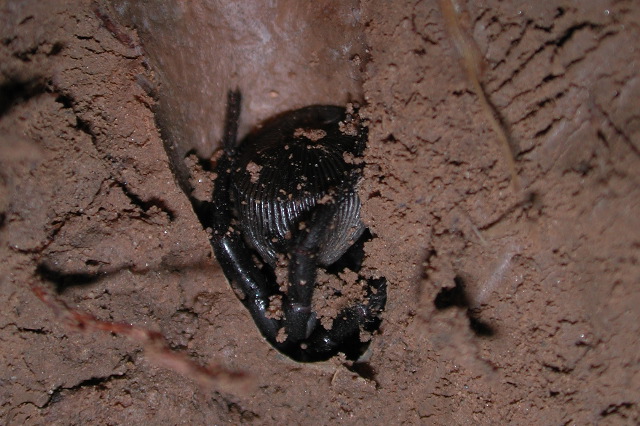
A spider which looks like a magical medallion

Description:
I have heard spider genus Cyclocosmia given the common names of trapdoor spider or coin spider. Both of these common names are problematic as they are also used for unrelated spiders. They use their abdomen to plug their hole when they are threatened. 

 This strategy has been recorded to have been successful in the repulsion of attacks from most spider's worst nightmare, pompilid wasps. As you can see, the posterior of the abdomen in Cyclocosmia is suddenly truncated giving it that unusual shape. It is also hardened and reinforced with ridges giving the appearance of some sort of ancient inscribed artifact.


Cyclocosmia are very long lived for a spider and have been known to survive up to 12 years in captivity. They are not very good disperses and are often found in close proximity to other members of the same species. By all accounts they seem to be fairly rare.

Distribution:
There are Cyclcosomia species  in east and south east Asia and in north and central America.

Classification:
Most members of the family Ctenizidia are referred to as trapdoor spiders as they have a similar lifestyle, however the word gets used for other taxa as well.
Kingdom: Animalia
Phylum: Arthropoda
Class: Arachnida
Order: Araneae
Family: Ctenizidia
Genus: Cyclocosmia

Image Links: